Showing posts with label Change. Show all posts

Tuesday, August 20, 2024

Three Evils


Some Things Will Never Change

The triple evils are racism, economic exploitation, and militarism. MLK, jr.

And he went on to say, "The great problem and the great challenge facing mankind today is to get rid of war … We have left ourselves as a nation morally and politically isolated in the world."

Has anything changed?

Racism

It is still with us. FBI data released in October 2023, showed there were 11,643 reported hate crimes in 2022. Other datasets show the numbers are likely much higher. The Bureau of Justice Statistics, for example, reported U.S. residents experienced about 246,900 hate crime victimizations each year between 2005 and 2019. (USA today) Statistics show most hate crimes are based on bias against people of color.

Economic Exploitation

The wealth gap continues to grow. This is from the Federal Reserve:

Black Families’ Wealth

  • Black families’ median wealth was $45,000 in 2022, growing 66% from 2019.
  • As a group, Black families owned 2% of total household wealth despite making up 11% of households.
  • Black families had 16 cents per dollar of white median wealth.
  • The Black-white gap grew to $242,000—up $47,000 from 2019

Income inequality is a global issue with several causes, including historical racism, unequal land distribution, high inflation, and stagnant wages. As gaps increase thanks to crises like COVID-19, the world needs to take action in education, labor market policies, tax reforms, and higher wages. (various online sources)

War

Of immediate concern to Dr. King was the percentage of African Americans fighting in the Vietnam War. According to the Library of Congress, African Americans made up 31% of the ground combat troops in Vietnam, while African Americans made up 12% of the population. Most of those fighting on the ground in Vietnam were draftees. Today's army is all volunteer.  

Big picture, there was concern funding for the war took funding away from social programs. In the 60's, the government spent on both the war and domestic projects. The economy over-heated and inflation went up. The increases in the cost of living affects the poor more.

Internationally, war affects women and children the most. It also displaces people, drives immigration,  increases poverty and suffering, and causes famine.

There are more conflicts now than at any time since the Second World War. "Deputy Secretary-General Amina J. Mohammed, stating that peace — the United Nations’ raison d’ĂȘtre — “is now under grave threat”, observed that people’s sense of safety and security is at an all-time low in almost every country.  Six out of seven worldwide are plagued by feelings of insecurity, the world is facing the highest number of violent conflicts since the Second World War and 2 billion people — a quarter of humanity — live in places affected by such conflict.  Recalling the Secretary-General’s words that “the world is at a key inflection point in history,” she underscored the need to rethink efforts to achieve sustainable peace." (United Nations)

Can things change? Yes! Will it be easy? No! Change I'll come about if we address the root causes of war. What? King would refer you back to the first two Evils on his list. West Point offers more perspective: Bumbling leaders, ancient hatreds, intransigent ideologies, dire poverty, historic injustices, and a huge supply of weapons and impressionable young men.


The Harvard Business Review (Ross Kanter) came up with ten reasons people resist change. The application was for business change, but I think the same reasons apply to social change.

Loss of control

Excess uncertainty

Surprise! surprise!

Everything seems different

Loss of face

Concerns about competence

More work

Ripple effects

Past resentments

Sometimes the threat is real 

Without change, there can be no progress. If there is no change, the number affected will climb beyond two billion. The world will be at war.


Friday, October 21, 2022

Things That Work / Change


How is a call to change named shame, / named penance, named chastisement? / How does one say / what if / without reproach?

- Claudia Rankine, “what if”

There is no progress without change. Without change, we get mired in the same downward spiral, and isn't it the definition of insanity to keep doing things the same way and expect a different result.

Change gets a bad rap because change is rarely perfect. Perfection isn't the goal. Improvement is! 

Standing in the door to block progress because it's not perfect is an excuse to do nothing. Those who would block change are invested in and profit from the status quo. Making life better for all is not in their self interest.

Monday, May 23, 2022

Deescalating Hate


 It Starts With Us

Take Action/Inspire Change

There's a United Way blog with eight things we can do personally to end hate. The blog was published to promote Nelson Mandela Day. 

Racial inequality and injustice were hiding in plain sight. Racism is now laid bare by a global pandemic and recent police violence in the U.S., South Africa, and throughout the world. "The systems and policies that cause health and economic disparities sprung from and are entrenched by the deep and enduring legacy of racism."

Mei Cobb's blog came up with eight actions we can take to inspire change.

  1. Register to vote and help others do the same.
  2. Examine and correct your own biases.
  3. Have conversations about race.
  4. Read to understand the history and impact of racism.
  5. Support anti-racism organizations.
  6. Advocate for laws that dismantle barriers to economic opportunity.
  7. Volunteer to improve the health, education, and financial stability of people living in poverty.
  8. Use your influence within your workplace and other organizations to address racial inequity.
  9. I would add another. Never give up.   

Seems pretty simple. What's in our way?  

We can only control what we do, how we react. Don't expect change overnight. Don't expect immediate change from others. Focus on their actions, their policies, not the person. Once you confront the person, the anger escalates. These nine actions are starting points. All are calls to action.


I


Wednesday, May 11, 2022

Anger


It isn't always a bad thing!

It can motivate us into action, making changes for the greater good.

We should all be angry. Anger has a long history of bringing about positive change; but, in addition to being angry, I'm also hopeful. Because I believe deeply in the ability of human beings to make and remake themselves for the better.

- Chimamanda Ngozi Adichie

The downside is when anger slips into rage. A certain amount of self-awareness can help keep from losing control. Anger is a very strong emotion. The loss of control leads to regrettable circumstance.

10 tips to tame your temper  (Mayo Clinic)

1. Think before you speak

In the heat of the moment, it's easy to say something you'll later regret. 

2. Once you're calm, express your concerns

As soon as you're thinking clearly, express your frustration in an assertive but nonconfrontational way. 

3. Get some exercise

Physical activity can help reduce stress that can cause you to become angry. 

4. Take a timeout

Timeouts aren't just for kids. Give yourself short breaks during times of the day that tend to be stressful. 

5. Identify possible solutions

Instead of focusing on what made you mad, work on resolving the issue at hand. 

6. Stick with 'I' statements

Criticizing or placing blame might only increase tension. Instead, use "I" statements to describe the problem. 

7. Don't hold a grudge

Forgiveness is a powerful tool. If you allow anger and other negative feelings to crowd out positive feelings, you might find yourself swallowed up by your own bitterness or sense of injustice. 

8. Use humor to release tension

Lightening up can help diffuse tension. Use humor to help you face what's making you angry and, possibly, any unrealistic expectations you have for how things should go. Avoid sarcasm, though — it can hurt feelings and make things worse.

9. Practice relaxation skills

When your temper flares, put relaxation skills to work. Practice deep-breathing exercises, imagine a relaxing scene, or repeat a calming word or phrase, such as "Take it easy." 

10. Know when to seek help

Learning to control anger can be a challenge at times. Seek help for anger issues if your anger seems out of control, causes you to do things you regret or hurts those around you.


Anger Can Motivate

Those seeking justice can use anger to motivate change. A good example is the Civil Rights Movement.

7 Benefits of Being Really Mad (PsyBlog)

1. Being really mad is a motivating force

You sometimes hear people talking about using anger as a motivating force by ‘turning anger into positive energy’.

2. Really mad people are more optimistic

It may sound like an odd thing to say, but angry people have something in common with happy people. That’s because both tend to be more optimistic.

3. Anger can benefit relationships

Being really mad is a natural reaction to being wronged by someone else and it’s a way of communicating that sense of injustice.

4. Anger provides self-insight

Being really mad can also provide insight into ourselves, if we allow it.

5. Getting really mad reduces violence

Although anger often precedes physical violence, it can also be a way of reducing violence. That’s because being really mad is a very strong social signal that a situation needs to be resolved.

6. Anger as negotiation strategy

Being really mad can be a legitimate way to get what you want.

7. Angry music is calming

Extreme music — like punk, heavy metal, death metal, emo and screamo — can actually have a positive, calming effect on anger  (Sharman & Dingle, 2015).

Realizing the cause of your anger can transition to, "Something has to change."


Tuesday, April 5, 2022

Time to Move On


Sure Signs It's Time to Go

Upon reflection, I think I stayed too long. The goal was to make positive change, and to create a listener service with a unique value for our public radio audience. A noble goal under appreciated by the people I worked for. In the end, the changes were made through tenacity. That tenacity may have had too high a price.

After turning around the station's unique value proposition among those who use public media I was let go. It happens. Change agents are often rewarded with exit papers. There's always uncertainty that comes with change. Despite our best efforts to inform senior management that change can be difficult, and that steadfastness is needed to endure the storm that accompanies change, senior management was not prepared.

My tenacity led to my disappointment.  The signs were there long before my exit. 

There's a passage in the Bible about going into a situation were your voice is being ignored.
If anyone will not welcome you or listen to your words, shake off the dust from your feet as you leave that house or town.
- Matthew 10:14

And the second part?
There’s really no such thing as the ‘voiceless’. There are only the deliberately silenced, or the preferably unheard.
- Arundhati Roy, Ordinary Person’s Guide To Empire (2004)

In all, it was a nine year journey to convince the major stakeholders that a shift was coming in audience expectations. The signs were there early on that we had hit the glass ceiling. Audience and development numbers had already flattened. It was only a matter of time. The downward turn was coming. I rang out the warning, presented the evidence and got ignored until it all began to collapse.

I should have left before that. It is a weakness to think you can change behaviors, when you can only change your own.

How do you know it's time to move on?

According to Destiny Agbanimu there are ten sure signs it's time to move on.
(LinkedIn October 2021)

1. Your trust is broken time and time again.

2. The situation makes you feel bad about yourself. It is time to leave and find a situation where you are appreciated.

3. The situation has lowered your self-esteem. 

4. When you think back, you are unable to think of the last time you were genuinely happy.

5. The relationship is not 50:50. It is time to find a relationship where you are treated as an equal.

6. You do not feel like you can openly express your opinion. you should never stay in a situation where you are not allowed to have a voice.

7. Promises are never followed through on. 

8. People want you to change into someone that you are not. If you are asked to go against your values and beliefs, or if the person has no consideration for how much that matters to you, then they do not respect you.

9. When words never match actions.

10. When the other person is too needy.

Much was accomplished. The cost was too high.

Destiny Agbanimu is a Business Development Manager | Product and Innovation Specialist | SDG 4 & 8 Advocate | Development Researcher.


Saturday, March 6, 2021

Making a Change

markus spiske

Never doubt that a small group of thoughtful, committed citizens can change the world; indeed, it's the only thing that ever has. -Margaret Mead

Inertia

A property of matter by which it continues in its existing state of rest or uniform motion in a straight line, unless that state is changed by an external force.
"the power required to overcome friction and the inertia of the moving parts"

I talk about inertia when I teach people how to drive. There are only three things that you can control to change inertia when driving. You can steer, you can use your brakes, or you can use your accelerator. Sometimes it's a combination of all three. A small change can make a huge difference. Yet, there are a substantial number of collisions (around 30%) where drivers took no action.

But I digress. Back to Margaret Mead. Looking her up in Britannica, Margaret Mead was an American anthropologist best known for her studies of the peoples of Oceania. She also commented on a wide array of societal issues, such as women's rights, nuclear proliferation, race relations, environmental pollution, and world hunger. Her thoughts on social change made her a target of conservatives.

An essay in Scientific American by  posits that her bashers owe her an apology. Most attacks on Mead focus on her ethnographic writings, notably her classic Coming of Age in Samoa: A Psychological Study of Primitive Youth for Western Civilization
"Her book nonetheless posed a challenge to Western sexual mores, which according to Mead inflicted needless suffering on young men and women. The metatheme of Coming of Age and all Mead's subsequent work was that the way things are is not the way they must or should be; we can choose to live in ways that make us happier and healthier. Her writings helped inspire feminism, the sexual revolution, the human potential movement and other countercultural trends during the 1960s."

Margaret Mead was a political progressive. Horgan points out that mead was  an outspoken critic of social Darwinism and eugenics, which in this pre-Nazi era were still intellectually fashionable. As a result of these influences, Mead opposed genetic determinism, racism, sexism, militarism and stultifying religious morality. She was biased—and she was right.

But was she right about change? Does a movement begin with an idea and end with a small group of committed individuals? There needs to be a point where the commitment of a few  becomes something larger.

Pettus Bridge

The first protest on March 7th was small. Led by Hosea Williams, one of Martin Luther King's SCLC lieutenants, and John Lewis, some 600 demonstrators walked, two by two, the six blocks to the Edmund Pettus Bridge that crossed the Alabama River and led out of Selma. They were literally beaten back. Press coverage changed that dynamic. Lewis spoke of how the civil rights music was able to change the dynamics through press coverage. “Without the press, the Civil Rights movement would have been a bird without wings.” 

There were actually three marches. The second march had two thousand participants. Martin Luther King turned the marchers back fearing the same outcome. By the third march, there ended up being 25 thousand when they reached Montgomery. Those who crossed the bridge were protected by 1,000 military policemen and 2,000 military troops.

The march was a pivotal point in the civil rights movement. As the numbers grew, the momentum, the inertia of the movement, became a force to strong to turn aside.

There have been times that I thought I couldn't last for long
But now I think I'm able to carry on
It's been a long, a long time coming
But I know a change is gonna come, oh yes it will. -Sam Cooke

Sunday, June 7, 2020

#Ending #Racism: What's Next?


Protests as Catalyst

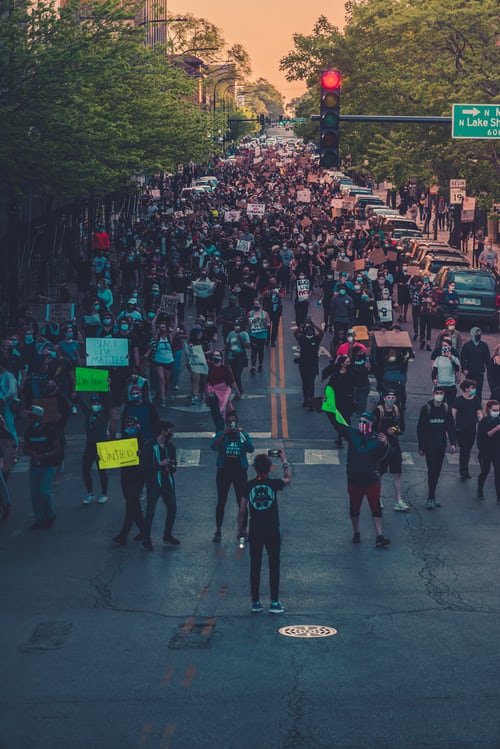
We've been here before


What can we do after the protests subside? The need will be the same. How can somebody like me help?

Link up with this article by NPR's Alison Aubrey, "Beyond Protests: 5 More Ways To Channel Anger Into Action To Fight Racism."  If you really want to help, understand that you're not going to reinvent the wheel, and don't go into this with the attitude that your going to lead this effort. There are a lot of orgranizations already deeply involved in this effort. You'll be there to lend a hand. Besides, thinking you'll be in control, is insulting to the people who are already involved in this effort daily. They have a wealth of experience. Listen to what they have to say.


Here are the five things we can do:

1. Listen To People Closest To You, And To People Of Other Races

2. Use Your Voice In Your Community And Work Place

3. Give Your Time

4. Speak Up By Using Your Creative Talents

5. Self-Care Is Important


Photo by Max Bender


Friday, December 6, 2019

Change is Essential

A Change is Coming

Without change there is no progress. There is no progress unless we all become motivated to make the change.

Progress is a nice word. But change is its motivator and change has its enemies.
- Robert F. Kennedy

Calling for change and doing nothing leads to cynicism and apathy.
Compassion is an unstable emotion. It needs to be translated into action, or it withers. The question is what to do with the feelings that have been aroused. . . . If one feels that there is nothing “we” can do — but who is that “we”? — and nothing “they” can do either — and who are “they”? — then one starts to get bored, cynical, apathetic.- Susan Sontag
If you're looking for reinforcement, the motivation comes from those who are willing to join together in a common goal. Sometimes the motivation comes from inspirational leaders like Gandhi and Martin Luther King, Jr. Sometimes the strength to move forward comes from music like Beethoven's "Eroica" Symphony or the Spiritual, "A Change is Gonna' Come."

Whatever it is, use all the tools at your disposal. It's takes perseverance and a willingness to be in it for the long haul. No matter the change, there will be those vested in keeping things the way they are. They might have the power for now, but their hold on power is subject to change. Their words will trip them. Their power will evade their grasp, if we are willing to speak up and are motivated to action.

Proverbs 11:17 “Your own soul is nourished when you are kind, but you destroy yourself when you are cruel.”


Sunday, June 2, 2019

Creative Barriers

The Recurring Dream


Over the past two weeks I've had variations on the same dream. I'm hire by a public radio station, given the charge to make things happen, only to discover there are endless barriers in place. Without resources...without commitment from the top, change can become more than difficult. The dream has a basis in my actual experience.

"We can't do that because we've always done it this way." "If you want the resources you need, find them, because we have other priorities." "Not now (not ever?)"

I guess I have unresolved issues, but there are things you can do to empower creative people. I found this at Robert Half.

Give employees a reason to care

The fact is, if people aren’t feeling connected to your company, there’s little incentive for them to be innovative.

Empower your employees to make decisions and take action

People who are trusted to take safe risks and attempt new ways of doing things just may stumble across that next great business solution. .

Don’t make staff jump through hoops

You may think that it’s easy for employees to offer their ideas, but is it really? If managers are constantly behind closed doors and meetings tend to be one-way discussions, the message to staff is that their feedback isn’t welcome.

Do what you can to remove the red tape

Consider which internal processes might be stifling innovation. 

Rethink competition

Setting up contests for individuals at work can be useful for goals such as achieving sales targets. However, be cautious about creating too competitive of a work environment when you’re trying to encourage innovation.  

Calm the naysayers

A key reason people often hesitate to offer fresh proposals is that they worry what others might say.  

Ease up

Employees who’ve been working sixty-hour weeks for months on end aren’t very likely to make notable contributions other than completing basic assignments.  

Make preventing burnout a high priority

Developing programs that promote work-life balance, such as offering telecommuting or paid time off for volunteer work, can help.  

Set the example

Recognize that as a leader, you are the model for the entire team.  

Do what you can to minimize your own stress so you can be at your best

It stands to reason that a relaxed, positive mood is more conducive to innovative thoughts than a tense one. Whenever possible, don’t skip your lunch break, and take a head-clearing walk when you need to recharge.

Monday, May 20, 2019

Stand


voice of the day

I believe that words are easy. I believe the truth is told in the actions we take. And I believe that if enough ordinary people back up our desire for a better world with action, I believe we can, in fact, accomplish absolutely extraordinary things. 

- Jody Williams

Voice of the Day is a regular feature of Sojourners 


Wednesday, December 7, 2016

There Is Something We Can All Do.

If you are unhappy with the results. If you are distressed by the lack of civility that has led to our deep divide...Doing nothing is not an option.


If change is going to happen...it is in our hands.

And what'll you do now, my blue-eyed son?
And what'll you do now, my darling young one?
I'm a-goin' back out 'fore the rain starts a-fallin'
I'll walk to the depths of the deepest black forest
Where the people are many and their hands are all empty
Where the pellets of poison are flooding their waters
Where the home in the valley meets the damp dirty prison
And the executioner's face is always well hidden
Where hunger is ugly, where souls are forgotten
Where black is the color, where none is the number
And I'll tell it and think it and speak it and breathe it
And reflect it from the mountain so all souls can see it
Then I'll stand on the ocean until I start sinkin'
But I'll know my song well before I start singin'
And it's a hard, it's a hard, it's a hard, it's a hard
It's a hard rain's a-gonna fall

Bob Dylan - A Hard Rain's Gonna Fall

Remember the post 9/11 line, "If you see something, say something?" How about, "If you see something, do something?" The Blue Eyed Son in Dylan's song went places and saw things, and heard things. He saw and heard so many things that seemed unjust. From a biblical perspective injustice is what happens when someone uses their power to take from someone else the good things God intended them to have: Their life, their liberty, their dignity, or the fruit of their love or their labor. (Jim Martin/The Just Church) Instead of walking away, he decided he was going to do something about the injustices. To the Blue Eyed Son this was all a call to action.