Showing posts with label WUMB. Show all posts

Friday, December 16, 2016

Old Haunts

Checking out old haunts. WUMB was my radio home for an ever so brief moment. Looking at the website....

Nothing much has changed


Looking at the ratings...
Nov 2016    AQH   Share   Daily Cume   Weekly Cume    Cume Rtg      TSL
WUMBFtlr  800        0.2      15,500            49,200                1.1                 1:45

Nothing much has changed


As long as the University supports them they will keep hobbling along. If that support were to fall away, the end would be swift and painful. The audience is just too small to support the station. By comparison, WERS has four times the share and almost four times the cume rating.

There is a critical mass when it comes to fundraising for public radio. The size of the Core Audience is the determining factor and the amount of time they spend with the radio station. Audigraphics made it easy to measure the size of the core, how often they tuned in and the duration of each occasion. Benchmarks for the core were about ten occasions a week with each occasion lasting about an hour. With an Average Quarter Hour Audience of 800 in the Boston Market and the audience turning over 19 times a day (62 times a week) it does not appear that WUMB has the numbers to support itself.

I was hired in 2010 to help turn things around. I didn't get a chance and that was disappointing. The lack of change since then is equally disappointing.  


Tuesday, February 18, 2014

Some Things Never Change

WGBH Shows Growth
In 2011, when WGBH made changes, they were roundly criticized. At the end of 2011 WGBH split off its news service and created a separate classical and music service on WCRB. There were loud complaints from WBUR about diluting the NPR news audience. There were complaints from long-time classical listeners. WCRB's signal was much weaker than WGBH's. Many in the system doubted WGBH's move, wondering if the news market in Boston could support two NPR stations. For its part, WGBH came to the conclusion they could no longer be a viable public media operation being all things to all people on one signal.

So what happened? Early results were not encouraging. Audience figures did not show growth. Despite the fact that looking at early results is unreliable, many thought it proved the point that WGBH had made a huge mistake.

Taking the Long View
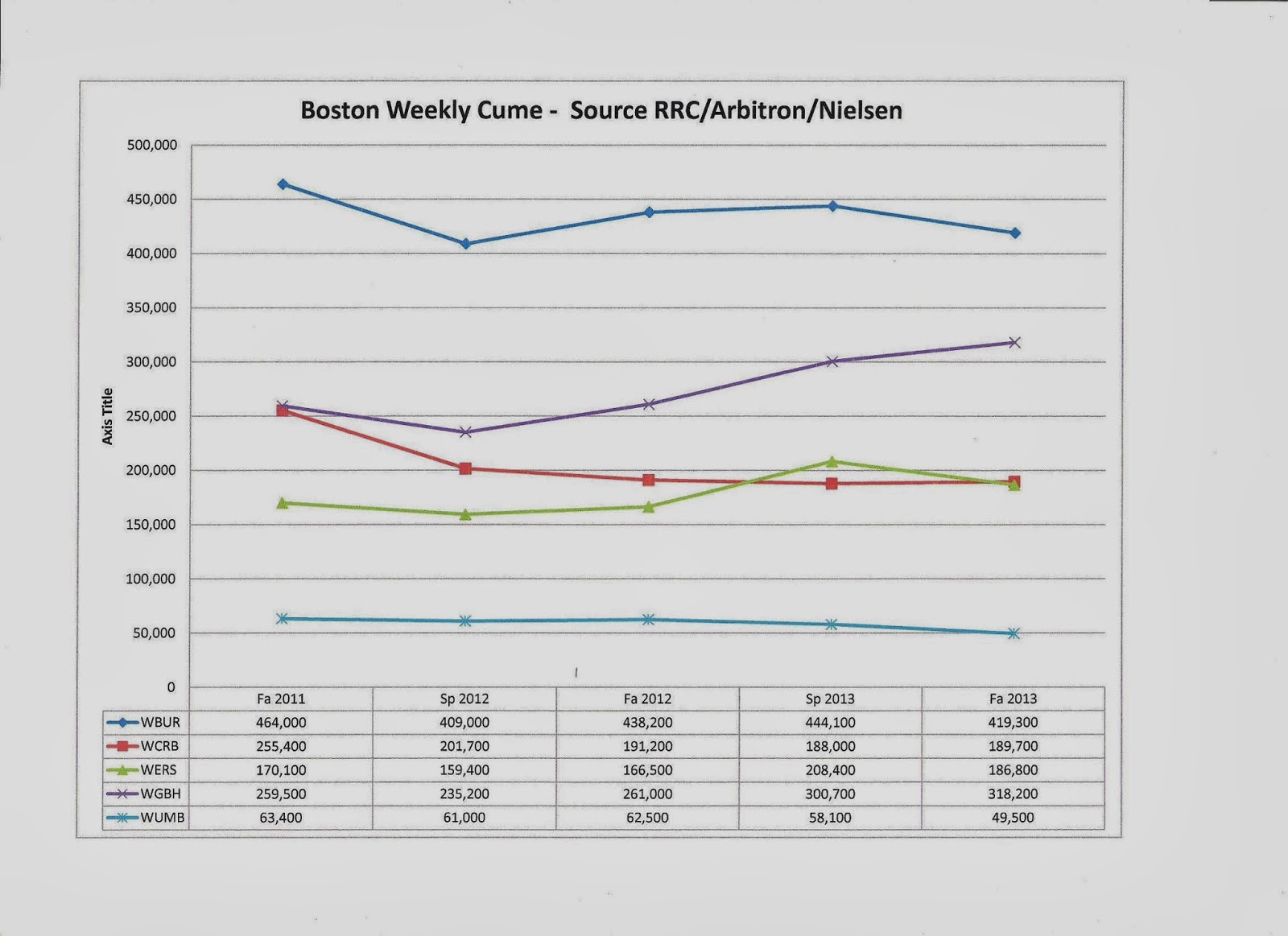
It has been over two years since the change. Enough time has elapsed to get an idea of audience trends. The results are mixed. WGBH is showing growth. WCRB (the station with the weaker signal) is not showing growth.  Looking at topline figures for five public radio stations using Fall and Spring Quarter data starting with the Fall Quarter from 2011 to the present you can get a sense of where things have gone in Boston. WBUR is holding onto its share of the Boston audience. WGBH is growing its average audience, share and cume. WCRB is declining in all three metrics. WERS, with its eclectic music programming, has a large weekly cume but, they have a very high turnover ratio. WUMB continues to bump against the bottom. Whatever they're doing isn't having much of an effect on the audience. I worked at WUMB for a short while at the end of 2010 and the start of 2011. Audience figures are pretty much the same as they were back then.

WGBH saw the need for change. Despite criticism and negative feedback, they are beginning to see postive results.

Steel Yourself
Change is something I'm familiar with. I helped shepherd two changes at WNPR. The first came in 1989 when WNPR took control of its programming in the morning. The phone calls and letters from contributors were sharply critical. The press was negative. Letters to the editor ran heavily against the changes. The results were positive with growth in audience and member dollars. In 2006, when the format changed to include more news and information, the feedback was more intense. The Hartford Courant devoted a front page article with a banner headline to the change. The article was not positive. It lamented the loss of classical music and, at the same time, included a sidebar with a list of eight other stations in the market that still carried the genre. Over 4,000 complaints came in from members. Major donors were bending the ear of the CEO. He had his doubts about the change from the beginning. The complaints reinforced his doubts.

Before the change we did our homework. We measured the effects the change would have on our membership by splitting them into groups called imperatives. They were News Imperatives, Crossover Imperatives, and Classical Imperatives. In our survey, we paid particular attention to what would happen to the Crossover Imperative. We already knew the News Imperatives would be supportive. And, we knew the Classical Imperatives would leave us. The question was, "Would the Crossover Imperatives remain in sufficient numbers to sustain our membership dollars over the short term?” The answer seemed to be yes. Still, there was some uncertainty. When contemplating the change it is important to understand that the reaction from many contributors will be negative. They contribute because they like the station the way it is.

It takes courage to make changes in public radio. The onslaught of complaints wilted some including senior management.  My performance review that first year was blistering.

A Positive Outcome
In the first year our audience grew and became more loyal. Membership dollars remained stable. The number of members decreased slightly. Our corporate and foundation support grew 500 percent!

Contemplating change? It takes research, planning and courage.

In the end, the Boston market may be robust enough to support competition for the Public Radio Audience.

The data below is from RRC, Arbitron and Nielsen. I've used AQH Persons, AQH Share and Weekly Cume to give a sense of the trends.


Tuesday, February 19, 2013

Is video the new radio star?

Inside Radio posted an article today about the importance of Video on a radio station's website. The article focuses on data gathered by comScore.

A new report from comScore shows that’s a smart strategy. The U.S. online video market attracts an average of 75 million viewers every day.  And content providers are doing a better job of monetizing those views. The gap between the number of video ad views and content views is narrowing, comScore data shows. The percentage of videos accompanied by a video ad jumped from just 14% in 2011 to nearly 23% in 2012.

Some public radio stations are on-board with this. Back in 2006 we did some early dabbling in video for radio at WNPR. We recorded and posted  the Steve Davis Quintet at Sweet Jane's in Hartford. It now has over 7000 views. WNPR's offerings are much more robust. WNPRVideo's Channel has 32 videos. The most watched is Kate Callahan and Two Doors with over 12,000 views.

WUMB919 (I had a cup of coffee with this station.) has 37 videos. Most of the views are in the 100's. The most recent video was posted about nine months ago.

WNYC has over 1500 videos. WNYC's Street Shots: Bruce Gilden, was posted about four years ago. It's a good example of the long tail of appealing on-line postings with over 600,000 views.

There are many more videos cross linked to each of these stations. An example of that cross linkage are videos posted by Colin McEnroe and the Real Life Survival Guide.

Still not convinced? YouTube is the second most utilized search engine behind Google. The platform is a must for your content.  A robust video strategy is going to bring more visitors to your station's website and will make more users aware of your content and your station.

And finally...According to the article from Inside Radio, advertisers (underwriters) are willing to pay higher cost per thousand rates for on-line video content and ads.

Monday, October 10, 2011

Shape of Things To Come

The Shape of Things
The Shape of Things to Come was an okay movie. It was adapted as Things to Come (1936) Actually, it put me to sleep. There way too much preaching. The song by the Yardbirds (Shape of Things) was much better. Jimmy Page plays the solo. But that's not the point of this posting.

In a recent blog I pointed to a frequency swap in Rhode Island that allows Latino Public Radio to offer programming 24/7 and gives Rhode Island Public Radio an FM signal on Providence. The other winner was Wheeler School. The Head of School, Dan Wheeler is quoted as saying, "streaming the student shows is actually the way our students listen to the radio these days."  The programming that was previously aired on 88.1 FM the Wheeler’s student station, will shift almost entirely to Internet streaming through a new website.  www.wheelerschoolradio.org.


The Future of Radio
I recently had a discussion with Paul Kamp and Richard Cerny of Backbone Networks Corporation. They see what Wheeler has done as the future of College and High School Radio...and perhaps the future of radio. They have 40 clients for their service. College Radio does not need to be tied to expensive terrestrial based stations. Backbone and their major competitor Live 365 make "Having your own Internet radio station is a lot easier than you ever imagined. Backbone Radio is truly a radio station on your Macintosh." Now, think about what Dan Miller said. "Streaming the student shows is actually the way our students listen to the radio these days." Cerny and Kamp also pointed out that Internet Radio is coming to automobiles. Some luxury models will be offering it soon. The same things was supposed to happen for HD Radio but, I don't think the same fate lies ahead for internet radio because of the proliferation of mobile media. The only thing holding back mobile media is spectrum. Demand for mobile media is likely to spur more spectrum. There does not seem to be a lot of demand for HD Radio.


Being There
The way the audience get their information and entertainment is changing rapidly. Public radio needs to be on the platforms being used by its audience and future audience. WUMB (A station I spent a cup of coffee with) is doing some of this by offering multiple streams of programming using Live365. The offer Celtic, Contemporary Folk, Traditional Folk, Blues and and a couple more streams on their 24/7 Music Streams. It's an attempt to super-serve their audience. Clear Channel is now offering I Heart Radio. Clear Channel is putting their 750+ radio stations on platforms that are preferred by many younger listeners. It also links their stations offering a service that promises to be similar to Pandora allowing users to create their own radio station. WUMB is not necessarily going after the same demographic, but on-line listening and mobile media is being adapted by a broad spectrum of public radio's older demographic.  WUMB has an iPhone App for their terrestrial signal. I'm not sure they have it for the Music Streams.


Backbone is optimistic about the future of internet radio. Their service can be used by low power stations, community radio stations, college stations and high school stations to extend their reach. It can also be used by stations willing to cut the chord entirely.


Friday, January 28, 2011

Show Prep / Topical Connections

In the PPM world it has become more important than ever to use the basics of AQH maintenance. We share with so many more stations than was assumed in the old diary method. Besides, there's a lot of competition for our listeners.

The idea is to keep the listeners listening and to increase occasions. Not only does it help ratings, it helps develop listener loyalty. A loyal audience is more likely to voluntarily contribute.

I'm consciously looking for those promotable moments. I work at a music station in Boston that specializes in Americana and all the elements that feed into that format. I'm always on the lookout for things that might entice the listeners to stick around or tune back in. There are two items that stood out for today's airshift.

A couple of days ago The Atlantic published an article about Ray LaMontagne. LaMontagne's album, "God Willin' and the Creek Don't Rise was in our Top Ten Albums of 2010. His 2004 release, "Trouble" is featured in an ad for The Travelers." Plus, he now lives in Western Massachusetts. I'll be connecting to the article and fashioning a tease to increase TSL.

I'm also on the mailing list for the World Cafe produced by WXPN. The Wold Cafe will feature Amos Lee today. Amos Lee has a new CD Mission Bell. I'll offer the same treatment with a couple of teases to promote TSL and use vertical promotion for our broadcast of World Cafe which airs on WUMB weeknights at 10pm.

Nothing is forced in either case. I'm working with music already scheduled on our play-list. Both artists are well within our format. Both artists are a draw for our audience. My topical connections will be short and to the point, but still give enough information to draw the listener in. It would be impossible to for me to do this without some advance preparation.

Tuesday, August 10, 2010

WHQR Hires Station Manager

Star News Online is reporting that Cleve Callison becomes WHQR's new station manager in September. The hiring is the next step in the road back for the Wilmington, North Carolina station beset with financial troubles in 2008 and 2009. Cleve was most recently Station Manager of WUMB at Miami of Ohio.