Showing posts with label RRC. Show all posts

Monday, May 30, 2016

Working Together in Public Radio: Does it matter?

This blog is not written to imply that radio broadcasting is the end all and be all of public media. There are too many platforms creating opportunities to reach the audience to think that one platform is better than the other. Instead it is meant to demonstrate how best to use the broadcast platform based on personal experience and the collective experiences of others. No matter the platform, best practices for that particular platform will help us reach our full potential to reach and engage the public media audience.

Yeah, it does! 

A few decades back when I was taking courses in Mass Communications and radio programming basics we spent a lot of time talking about increasing time spent listening and reducing barriers to listening. The models we worked on were commercial formats.

The question of stationality came up in a couple of job interviews. How would you change the culture here to make us one station? The question came up in a different way recently when I was asked to examine the weaknesses in a particular station's weekday schedule. Their weekdays are filled with a hodgepodge of programs provided by independent producers primarily concerned with their content rather than appealing consistently to an audience. The end result is long stretches of audience data that barely registered above zero.

Why look for examples of success among commercial broadcasters? The thinking was, the best way to attract and keep an audience was consistency of format and super serving the target audience. We discussed music formats and news formats and using rotations and solid forward promotion strategies to keep listeners listening. We also looked at consistency. Inevitably, people will tune away. Once they tuned back in, the successful station delivered the programming the core audience expected to hear.

Eliminating barriers to listeners is the same thing as eliminating seams. It is not be possible to eliminate them all. Some are easier to eliminate than others and, I am not advocating blandness and the safety of banality. But.. Public Radio is filled with examples of seams and barriers. A few examples include...

  • Opening and closing themes.
  • Billboards.
  • Hellos and long goodbyes.
  • Self-encased hour long programs
  • Announcers who say "I'll be back," "All of you out there."
  • Announcers who think in terms of "my show."
  • Checkerboard schedules that promote churn.

The Best of Intentions

At my first public radio station we used to run feature news stories during our music programming. The intent was to highlight news content as a sort of cross promotion during the music programming stream. It didn't work. The music imperatives hated the interruptions and tuned out. The news imperatives never tuned in. We were creating huge seams in our programming suppressing time spent listening and audience loyalty. At my second station something similar was happening. We programmed all sorts of modules during music programming. These things had introductory music and closing themes with goodbyes from the host. There were gardening modules, star gazing modules, ecological modules, business modules and more. Instead of being intriguing bits of informative programming, the audience thought of them as interruptions. They tuned out. We created huge seams because we thought the public radio listener wanted this kind of information. We should have asked first.

Not for Lack of Effort

There have been attempts at creating midday and weekend streams that have a consistent appeal with the public radio tent poles...Morning Edition and All Things Considered.  To date, the attempts have been less than successful. Think about what's happened to Weekend America, Talk of the Nation, Performance Today and Modal Music. Meanwhile, we're looking for the next Car Talk and Wait, Wait! The later two worked because they appealed to the same audience that values All Things Considered and Morning Edition. They also work because listeners can tune-in at any point in the program and understand what is going on...just like ATC and ME.

To find out what's working, look at where the core audience gravitates. Look at which programs draw that audience on a consistent basis. Unfortunately for the stations with poor results, there's even longer stretches of no core audience. Without substantial core appeal, the ability to raise funds from listeners is almost nil.

Finding programming that fits well together is only a part of the programming game. So is forward promotion. A focused promotional effort on what to expect in the next ten to 20 minutes promotes time spent listening and can help bridge the natural gaps between programs. Forward promotion, vertical and horizontal promotion are a station's most effective on-air promotional tools. Promotions can also give stations a sense of unity and purpose.

There's loads of research on effective programming strategies for public radio. Some good places to start include the Radio Research Consortium, Public Radio Program Directors Association, Walrus Research, Audience Research Analysis and Corporation for Public Broadcasting.

I've been asked and, at times, castigated, "Why do research? This is public broadcasting. We can do anything...and they will come." Those days are long gone. With new platforms drawing away audience, the stakes are too high not to be paying attention to what your audience wants. If you want to do your own thing, start a podcast. If you want an audience, just be sure you know what you're doing, and how to listen then engage.


Monday, October 12, 2015

I Listen to Pledge

Maybe I should Stop

I admit it. I'm an armchair program director. Others who have held that position in the past admit to the same malaise. I listen and I can't help myself. Maybe it is because it seems like content directors (PD's) in the public radio system seem to want to keep learning the same lessons we (the old timers) did long ago.  There I was listening and analyzing the pitching and the content.

Three Minutes...Three Mistakes

Pledge has been raging on for over a week. Maybe I'm just cranky. Today I listened to the talent acknowledge a pledge from a regular guest on the show that was being pledged. She said the gauntlet was down for other guest talent of this show's regular segment to pledge. What's wrong with that? She just let the other 12,000 listeners off the hook. She pitched exclusively to a half-dozen people. Since radio is a companion...personal...the best pitch appeals to the individual, not to groups or to insiders.

Then I heard the other talent talk about what a commitment the station was making with three local productions daily. The station invests heavily in local production. That was it. Is the pitch self-evident? No! She needed to answer why. Why is it important to be local? What is the benefit to the listener? How is the station better serving the audience with local productions? I never found out. It is important to understand that local for the sake of being local is not important to the listener. It is the quality of the content and whether or not that content meets the listener's expectations.

Wasted Promotions

After the pledge break, the station promoted a one hour program airing on Sunday night. It was Monday afternoon. I can't for the life of me remember what was being promoted, but that is the point. The most effective promotional strategy is forward promotion/vertical promotion/horizontal promotion.  Forward promotion is for content coming up in the next 20 minutes. It encourages time spent listening. It should be been placed just before the break. Vertical promotion is something that is focused on content coming up later in the day. This was in midday so, perhaps, a promotion for All Things Considered would have been best. Horizontal promotion is for programming content in the same day-part in the next day. Vertical and horizontal promotions create more occasions. At the very least, promotions are most effective if they inform the listeners of something happening on the air within the next 24 to 36 hours.  The promotion aired by the station used a diagonal strategy...and this is considered the least effective of all the promotional strategies. This particular station does this a lot.

It's Radio - Not Rocket Science

I feel fortunate. I learned these strategies by listening to those already in the system. I participated with others in what it takes to gain and maintain and audience through PRPD ARA (Audience Resource Analysis), Walrus Research, RRC, Station Resource Group, and other people and organizations.  The information is out there. You don't need to reinvent the wheel. Ask.

To Paraphrase, Old PD's never die, they keep looking for opportunities to increase occasions and duration. Even during pledge.

It's basic radio - Think Audience


Thursday, February 19, 2015

Ebbing Loyalty


Image result for on point

Straight to the Source

Earlier today, I wanted to listen in to the debate about Scott Walker's proposed cuts to the University of Wisconsin System. WBUR's On-Point put together a program about the cuts with several guests including:
  • Karen Herzog, higher education reporter for the Milwaukee Journal Sentinel. (@herzogjs)
  • Noel Radomski, director of the Wisconsin Center for the Advancement of Postsecondary Education. (@noelradomski)
  • Christian Schneidercolumnist at the Milwaukee Journal Sentinel. (@schneider_cm)
  • John Sharpless, professor of history at the University of Wisconsin, Madison. Republican candidate for the United States House of Representatives from Wisconsin’s Second Congressional District in 2000.

Convenient Listening

I used to work at WNPR in Connecticut. I still live in their listening area. You would think I have a certain amount of loyalty to the station. Despite my layoff from WNPR in 2009, I still help them raise money during pledge. I still listen while driving. But now, I hardly ever listen at home. Instead of listening to the feed from WNPR, I chose to listen to the feed from WBUR. I went directly to the source. 

Since I was unable to catch the program from the start (I listened on-line about half-way into the program), I will listen to the first half of the program later through the On-Point web page. It's a lot more convenient.

Loyalty

Does this mean I'm less loyal to WNPR?  It does! Here's how the Radio Research Consortium looks at Loyalty.
Loyalty is the total QHs of listening to your station expressed as a percentage of all QHs of listening to radio in your listeners’ diaries. It is a measure of how well (or how poorly) your programming elicits listening by your cume. Here is how to interpret this Loyalty rate: Of all the quarter-hours of listening to radio over the entire survey week by your 106,700 metro area cume persons, 37.1% of those QHs were spent with WRRCFM. The audience is 37.1% loyal to the station. What does the level of loyalty indicate? Low loyalty suggests you may be trying to serve too many constituencies. High loyalty, but low cume says you are superserving too small a target audience. High loyalty and high cume means you are doing a good job of bringing people in and keeping them involved with the station.
My loyalty may actually be the same. The percent of Quarter Hours devoted to WNPR might still be the same as before, but my listening to radio is less than it once was. The total number of Quarter Hours is a lot less than it was ten years ago. I still I listen to WNPR 50% of the time...that share of pie is still the same, but the pie is smaller.

Image result for wnprDoes this Matter?  

Loyalty is important when it comes to fundraising. So is the number of Occasions. My total listening time is down.  The more loyal I am as a listener to a public radio station...the more likely I am to contribute. My time spent listening matters to. As I spend less time listening...My willingness to contribute diminishes.        

AQH Persons

A way stations can determine if listeners are spending less time with their programming is to look at Time Spent Listening and the Average Quarter Hour Audience. For this example, I did for WNPR. In the past two years AQH is down 29% and TSL is down 19% in the Hartford Metro Area. The trend suggests it will be harder for WNPR to raise money from listeners. John Sutton from RadioSutton, a Public Media consultant, suggests that reductions in AQH require stations to use more leverage during fundraisers to meet their goals. For more information on the use of leverage, please read, "It’s Taking More Leverage to Generate Pledge Drive Contributions."

What's Next?

WNPR can help itself. It can make sure they are making the most of forward promotion opportunities. They can also carefully examine the appeal of its programming. They can look at which programming elements are drawing audience and which are not. WNPR can also realign resources to programming that defines their audience. They can then determine where changes are needed. They can also make sure they have a robust on-line and social media presence. I will need reasons to listen to their content on-line and on-demand. If they can do all that, they might be able to get me to spend more time listening to their content. By doing that, my time spent listening to their content will rise.


Saturday, December 6, 2014

It's Not About the Mugs

Really!


I was listening to my local public radio station this morning as they kick off their fund drive. The announcer says, "I'm going to talk directly to the listeners now." He then went into a two minute pitch about coffee mugs.

Who, exactly, was he talking to before? 


Radio a personal medium. Listeners develop loyalties to radio stations based on the content and how well that content speaks to their personal values and fits in with their lifestyle. Radio stations that resonate with listeners become companions.

In the 60's Marshall McCluhan talked about radio,  “Radio affects most intimately, person-to-person, offering a world of unspoken communication between writer-speaker and the listener. That is the immediate aspect of radio. A private experience. The subliminal depths of radio are charged with the resonating echoes of tribal horns and antique drums. This is inherent in the very nature of this medium, with its power to turn the psyche and society into a single echo chamber.”(Understanding Media:The Extensions of Man,Marshall McLuhan)  

Telling Stories


And, that is why storytelling is so important. McCluhan points out in Understanding Media, If we sit and talk in a dark room, words suddenly acquire new meanings and different textures. They become richer, [...]. All those gestural qualities [...] come back in the dark, and on the radio. Given only the sound of a play, we have to fill in all of the senses, not just the sight of the action. So much do-it-yourself, or completion and “closure” of action, develops a kind of independent isolation in the young that makes them remote and inaccessible.” (264) 

The same holds true for Public Radio. The platforms are changing. Radio is no longer considered the disruptive media, Social Media is. Perhaps radio has lost some of its edge because of the homogenization of the medium by large corporations like iheartmedia. Through Social Media there are many more venues for the content. But, the core values...the reasons for listening and loyalty...are the same.  

The station I was listening to is an NPR news stations. According to PRPD's Core Values Project, "In news, we met listeners who are deeply engaged in contemporary public life and culture; whose vigilant curiosity about the world brings them to public radio for depth and context. They see the world as part of an interconnected web of causal relationships and want us to help them connect the dots by focusing on the "why", not just the "what" of issues and events. They believe in the power to find solutions for the problems of their community, their nation and their world."

Understand Your Audience


I used to be employed in Public Radio. I still have my PRPD 20th Anniversary mug. Inside the mug, toward the the rim, it says, "Think Audience." That maxim came out of the Radio Research Consortium (RRC) in the late 70's.  Tom Church, the founder of the RRC championed working with Arbitron data as a way to measure response to our programming. John Sutton puts it well. "Church didn't say "Think Share Points" or "Think Cume." His words were "Think Audience" and their purpose was to get public radio programmers to focus on how listeners respond to a station's programming."

There is so much information about what makes radio, and public radio appealing. There is so much that public radio is doing right by telling stories that put issues and ideas into context. There's nothing in there about mugs. So, why is that the fall-back position for fundraising?

Tuesday, February 18, 2014

Some Things Never Change

WGBH Shows Growth
In 2011, when WGBH made changes, they were roundly criticized. At the end of 2011 WGBH split off its news service and created a separate classical and music service on WCRB. There were loud complaints from WBUR about diluting the NPR news audience. There were complaints from long-time classical listeners. WCRB's signal was much weaker than WGBH's. Many in the system doubted WGBH's move, wondering if the news market in Boston could support two NPR stations. For its part, WGBH came to the conclusion they could no longer be a viable public media operation being all things to all people on one signal.

So what happened? Early results were not encouraging. Audience figures did not show growth. Despite the fact that looking at early results is unreliable, many thought it proved the point that WGBH had made a huge mistake.

Taking the Long View
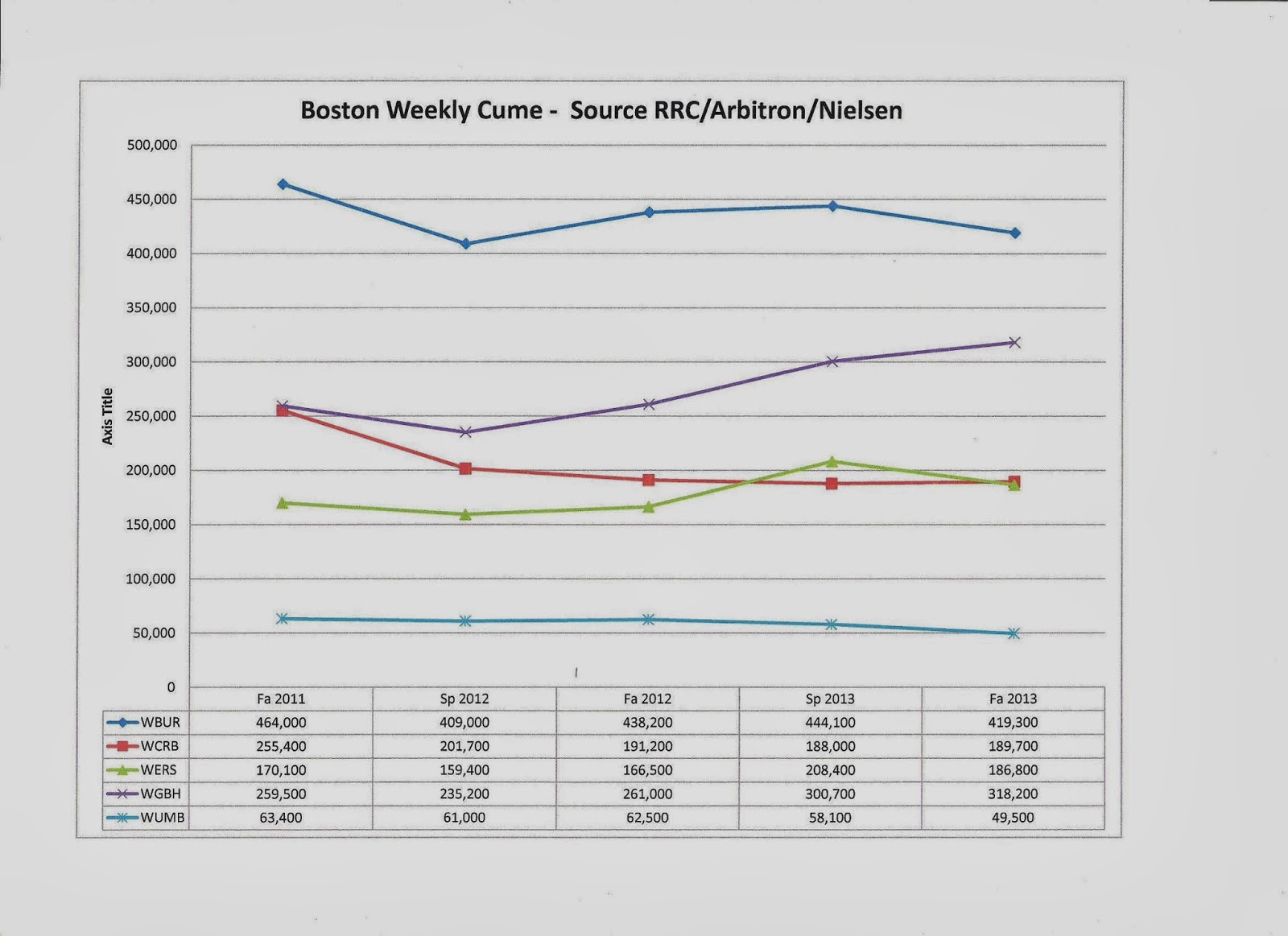
It has been over two years since the change. Enough time has elapsed to get an idea of audience trends. The results are mixed. WGBH is showing growth. WCRB (the station with the weaker signal) is not showing growth.  Looking at topline figures for five public radio stations using Fall and Spring Quarter data starting with the Fall Quarter from 2011 to the present you can get a sense of where things have gone in Boston. WBUR is holding onto its share of the Boston audience. WGBH is growing its average audience, share and cume. WCRB is declining in all three metrics. WERS, with its eclectic music programming, has a large weekly cume but, they have a very high turnover ratio. WUMB continues to bump against the bottom. Whatever they're doing isn't having much of an effect on the audience. I worked at WUMB for a short while at the end of 2010 and the start of 2011. Audience figures are pretty much the same as they were back then.

WGBH saw the need for change. Despite criticism and negative feedback, they are beginning to see postive results.

Steel Yourself
Change is something I'm familiar with. I helped shepherd two changes at WNPR. The first came in 1989 when WNPR took control of its programming in the morning. The phone calls and letters from contributors were sharply critical. The press was negative. Letters to the editor ran heavily against the changes. The results were positive with growth in audience and member dollars. In 2006, when the format changed to include more news and information, the feedback was more intense. The Hartford Courant devoted a front page article with a banner headline to the change. The article was not positive. It lamented the loss of classical music and, at the same time, included a sidebar with a list of eight other stations in the market that still carried the genre. Over 4,000 complaints came in from members. Major donors were bending the ear of the CEO. He had his doubts about the change from the beginning. The complaints reinforced his doubts.

Before the change we did our homework. We measured the effects the change would have on our membership by splitting them into groups called imperatives. They were News Imperatives, Crossover Imperatives, and Classical Imperatives. In our survey, we paid particular attention to what would happen to the Crossover Imperative. We already knew the News Imperatives would be supportive. And, we knew the Classical Imperatives would leave us. The question was, "Would the Crossover Imperatives remain in sufficient numbers to sustain our membership dollars over the short term?” The answer seemed to be yes. Still, there was some uncertainty. When contemplating the change it is important to understand that the reaction from many contributors will be negative. They contribute because they like the station the way it is.

It takes courage to make changes in public radio. The onslaught of complaints wilted some including senior management.  My performance review that first year was blistering.

A Positive Outcome
In the first year our audience grew and became more loyal. Membership dollars remained stable. The number of members decreased slightly. Our corporate and foundation support grew 500 percent!

Contemplating change? It takes research, planning and courage.

In the end, the Boston market may be robust enough to support competition for the Public Radio Audience.

The data below is from RRC, Arbitron and Nielsen. I've used AQH Persons, AQH Share and Weekly Cume to give a sense of the trends.


Friday, November 25, 2011

Hartford Metro Drops Rank

This and That

According to the Arbitron Ratings Service, the Hartford Metro is no longer in the top 50 markets. Recent ratings releases show the Hartford Metro has fallen to number 52. In the 2010 Census Hartford County actually had a population increase of 4.3%. The increase was  not enough to increase the growth in other markets. The Hartford New Haven DMA is still ranked 30th. Market rank and population help determine the rates commercial radio and television stations use for advertising. Public broadcasters also use the market designations as a benchmark for hiring staff.

WNPR is the top ranked public radio station in the Hartford Metro. Nobody else is coming close.
According to Arbitron and RRC (Hartford Metro PPM Person's 6+ October 2011):
WNPR     4.1% Share
WJMJ      1.4% Share
WFCR     0.9% Share
WYBC     0.9% Share
WQTQ     0.7% Share
Everybody else is listed as having a 0.1% share. WNPR may be benefiting from the way PPM collects information. PPM picks up actual listening among those chosen to be in the sample. The diary method used recalled listening. Under the diary system, WNPR used to run neck and neck with WJMJ and WFCR in the Hartford Metro. WNPR's decision to focus its format on Public Radio News and Information from a split format also has helped improve its share. WFCR's numbers in the Hartford Metro are skewed by it's signal. WFCR's signal covers the northern half of the Hartford Metro. Signal strength also skews WNPR's coverage. WNPR effectively covers the southern two-thirds of the Hartford Metro. 

WNPR recently reached an agreement with WAIC and American International College to broadcast on their frequency out of the Springfield area. The added frequency fills in some of the holes in the northern part of the Hartford Metro for WNPR.

A Market Opportunity
The region's only full-time AAA station, WRNX, Amherst recently switched formats to Country Music. WRNX has a weak signal into the Hartford Metro, but could be heard in the northern portions of the Market. A full-time AAA station might be an opportunity for a non-commercial station in the Hartford and Springfield markets. WRNX used to pull in between a 1.5 and 2.0. WRNX is owned by Clear Channel.

Monday, August 22, 2011

WBUR/WGBH Revisited

WGBH and WBUR continue to compete for the same market share...the NPR news listener. It was feared when WGBH switched formats to News and information that the move would split the audience. It hasn't quite turned out that way.

Certainly WBUR lost share of the market while WGBH made very modest gains. More importantly, public radio collectively lost share of the Boston Market. Public Radio's Share of the market, (Persons 6+) according to PPM data provided by RRC, has dropped from 9.5% to 7.0% of the radio audience.


I compared the quarterly topline reports from Winter 2010 to Spring 2011.
Without more data, I can only guess at what is happening. It seems public radio is less appealing now to the Boston Market than it was in the Winter of 2010.


Monday, April 25, 2011

WBUR - Feeling the sting of competition Part Two

WGBH changes sting public radio rival - The Boston Globe

One of the things we used to talk about was that having more stations below 92 on the dial would raise all boats. That is, if there were more stations carrying NPR content, more listeners would come to public radio.

My question - are more listeners coming to public radio after the switch by WGBH to NPR news/talk? I cannot give you public radio's total Cume audience. I can give you public radio's share over time.


Based on topline figures the trend line shows public radio's share of the market is decreasing. WGBH's trend line is slightly upward. WBUR's trend line shows they have lost about a half point.  Average audience for public radio is also declining. Declines in share and average audience for WBUR may be due in part to increased competition between WGBH and WBUR. Another factor is a decline in Public Radio's share of the radio market. Decreased listening to public radio in the Boston market is contributing to WBUR's decline.


One more thing to consider.  The starting point...the month WGBH switched formats...may be skewed. The increased attention brought on by the publicity may have inflated the number of listeners sampling public radio. Eliminating December 2009 from the chart slightly lessens the decreasing trends for public radio and for WBUR, but not entirely.


Sunday, April 24, 2011

WGBH changes sting public radio rival - The Boston Globe

WGBH changes sting public radio rival - The Boston Globe

I'm bothered by the horse race aspect of this article.

Here's why:
A weakness of the month to month system employed by Arbitron with PPM is the volatility of the numbers. To be sure, they are more reliable than the diary numbers. Still, there is a certain amount of bounce in the estimates from month to month. 


Using trends is much more reliable. The six month average in The Vital Signs Report available to public radio stations by RRC offers even more reliability.

Trending average audience share figures from Arbitron 6+ PPM Metro Boston show modest gains for WGBH in the past six months. WBUR's trend is flat. The other major player among public radio stations in Boston,WCRB, is trending downward.

The numbers being used are for Boston Metro and do not reflect the audience estimates for WGBH and WBUR outside the Boston Metro Market.


            Nov 10  Dec 10  Hol 10  Jan 10  Feb 10 Mar 10 
 WBUR 3.9%     3.5%     3.1%    4.0%    3.7%    3.6% 
 WCRB 2.4%     2.2%     2.9%    2.4%    1.9%    2.1% 
 WGBH 1.5%    1.4%      1.2%   1.7%     1.6%    1.4%  

Sunday, June 27, 2010

After format swap, WGBH lags behind WBUR in ratings

After format swap, WGBH lags behind WBUR in ratings
Found in the Boston Herald.com by Jessica Heslam.

The 1.0 share for WGBH has to be disappointing. It is not the end of the world.
There are two great comments that put this into perspective.

Boston radio consultant and Lesley University professor Donna Halper said this is a marathon - not a sprint. “I’ve been consulting for 30 years and there is no history of a talk radio format, particularly on public broadcasting, storming in and taking over the world,” Halper said.

While WBUR has WGBH beat so far, Fleming said his station is still concerned about the newcomer, but it’s forced them to “focus in on what we do well.”

If this is going to work for WGBH, they will need to take the long view. The news is not so bad for their classical service. WCRB has 2.2 share in April and a 2.6 share for the winter quarter according to Arbitron and the Radio Research Consortium.


Monday, March 29, 2010

Shifts In Radio Listening Habits

The Personal People Meter…the new method for measuring radio listening habits…is changing the classical music landscape. Two high profile changes came about last year when WCRB and WQXR were sold to public radio stations. Recently KING-FM in Seattle reported they would change to a non-profit status and take donations. According to KING-FM, advertisers were no longer willing to support the station. At least in the numbers needed to sustain the programming.

A New York Times article by Stephaine Clifford from December 2009 (Never Listen to Céline? Radio Meter Begs to Differ) asserted that classical music fans listened to classical music on the radio a lot less than they had been reporting under the old diary method.  My experience in Connecticut would seem to confirm that. When the station I worked for started getting information from Audience Research Analysis (ARA), the Audigraphics information was adjusted to eliminate diary keepers who seemed to be listening to our station 24 hours a day. Eliminating those four or five diary keepers per quarter had a minimal effect on our weekly cume, but it had a great impact on core loyalty figures and station use figures. It was the first evidence I had that diary keepers were willing to put down what they thought should be in their diaries rather than a true reflection of their listening habits.

Do I listen to Celine? The answer is yes, but only if I have to. It depends on who I am with and who has control over the radio. If I’m riding in the car with my sons, I get to listen to a lot of hip-hop and urban contemporary. That is not my preferred format, but if I had a PPM device on my belt, those station would register as part of my listening habits. Under the diary system, because I did not choose hip-hop, I might not have put that station down as part of my listening. Under the PPM system, my listening might be considered collateral damage depending on your point of view.

According to research from The Radio Research Consortium, it turns out most of us listen to about 12 radio stations on a regular basis. That three to four times as many as previously thought under the old diary method. The common wisdom was that most of us shared our listening with three or four stations. In actuality we spend a lot less time with our favorite station than previously thought.

The resulting lower numbers means that advertisers are gravitating to stations that do better on the PPM system. According to the article in the Times, Country, Oldies and News have fared better. Niche formats like Smooth Jazz and Classical have not.

Tuesday, December 15, 2009

Grow the Audience - Using the Basics


Using the Basics to Regain Audience
WNPR changed formats in the summer of 2006. Within the first six months the audience started to show strength. Loyalty figures were up. The weekly Cume was up and the average audience started to rebound. We also saw a jump in underwriting support. Then in late 2007 we started to see evidence of a leveling off in audience figures and then a decline in 2008.

Time For Change
Changing the program strategy at WNPR resulted in audience growth. The changes made in the summer of 2006 resulted in about a 20% increase in total audience and about an eight percent growth in average audience. The early growth was the result of the newness of the format in
Connecticut. Up to the summer of 2006 nobody else was offering most of Connecticut the NPR news and information format. WNPR was the first to do so.

The changes were dynamic and dramatic. Accomplishing the changes were challenging in the face of healthy skepticism from senior staff, certain stake-holder in development and, the Board of Trustees. They questioned the need for change when the bottom line at WNPR was still relatively healthy.

There were signs of weakness in the longstanding hybrid format of NPR News, Classical Music and entertainment programs like
 A Prairie Home Companion, Car Talk and Wait, Wait! This formula had worked well since 1989. Why change? Loyalty figures were slipping, WNPR's dominance over other public media outlets was eroding. Membership was flat and trending slightly downward. Underwriting booked exclusively for WNPR was weak. Most of the underwriting on WNPR was sold as part of a package that included CPTV and Connecticut Magazine. WNPR had over 20,000 contributors, but the majority was radio and TV combined. Major donors for radio were almost non-existent. We had less than 100.

The Glass Ceiling
Research consultants told us in 2004 and 2005 that we were reaching the glass ceiling. The potential for growth had plateaued. Predictions were for a gradual decrease in audience and member support in five years. Among the issues facing WNPR was the lack of unique programming. The picture wasn't entirely bleak and desolate. Working in our favor was a very strong news department, and a well established daily talk show produced in our New Haven Studios,
 The Faith Middleton Show. The rest of the program schedule was duplicated by two very strong public radio stations WFCR and WSHU. Added to that WNPR had very little geography that was exclusive. Almost everything we did was duplicated by these two stations.

Declining Market Position
The decline came much quicker than anticipated. WNPR's main transmitter failed during an ice storm in late December 2004. Replacement parts were not available and had to be custom made. 90.5FM was at half power for six months. Making the situation worse was an engineering mistake in the design of the structure supporting WNPR's satellite dishes. Connecticut Public Broadcasting moved to a new facility in the summer of 2004. The dishes were placed on top of the new building. Because the supports were under-engineered, the dishes would blow around knocking them slightly out of alignment. The results were garbled signals from our national programming sources. It took many months to sort out the structural issues. During this period we were beginning to see declines in average audience, share and time spent listening. The catastrophic failure of our main transmitter pushed WNPR over the edge. WNPR lost 70,000 listeners and membership support declined 12%. After the transmitter was repaired the audience did not come back. The audience found the programming they wanted just as satisfying on our competitions' stations.

Justifying Change
The changes we made in 2006 came after some intensive research into the listening habits of our membership. The research was conducted by Arthur Cohen and
 Whole Station Solutions, and Peter Dominowski and Market Trends Research who did most of the call-outs and helped us design our survey. The results of the survey did not result in a certainty that we should change our programming focus. That was because, in large part, we surveyed members who were classical imperatives, classical/news imperatives and news/classical imperatives. We wanted to know the impact of the decision to change programming focus. The evidence suggested this was the right direction to take for WNPR's future. Many of the stakeholders still needed convincing, and even a year after the changes there were still doubts that we had made the right decision. The doubts rose mostly around the response of the membership.

The growth in audience came quickly but, there was rift in our membership universe. Members of the Board and senior management were anxious because positive results were not immediate. Fortunately, the growth in underwriting more than offset the declines in member support. Membership bounced back in the second year.

An Audience Slump
In late 2007 and early 2008 we started to notice a decline in audience. Total audience, average audience and share declined. Our share fell from above 3.0% to about 2.6%. We were not sure what was happening. We still had market exclusivity for NPR News and Information.
 Morning Edition and WNPR's daily news program, Where We Live, continued to show audience growth and strength. The declines were clearly evident middays during All Things Considered and weekends.

The Decision for Gradual Change
Instead of pulling the trigger on wholesale program change, I decided to focus on micro-formatics. I listened to and analyzed what was being said in our midday, PM and weekend breaks. At issue was the lack of structure within those breaks. We were not taking full advantage of the opportunity for quarter hour maintenance. Our promotional schedule was filled with diagonal promotion strategies. We were spending a lot of time promoting to programs that did not have much impact on our audience.

Vertical and Horizontal Promotion
With the help of the PRPD handbook and because of my own experience in programming, we got better at the basics. We used a lot more teasing. Since midday programming did not allow for a lot teasing about what was coming up in the next 20 minutes, we chose to focus on the next program or the program after that. Teases were placed first in the break. Produced promotions focused on the programs that drove our core audience. Those programs were
 Morning Edition, Where We Live, the Faith Middleton Show, All Things Considered, Marketplace, and the weekend hits. And, whenever possible we employed horizontal promotion. We made an effort to highlight what was coming up the next day at the same time.

Positive Gains
WNPR gained back audience. There were gains in the weekly audience (Cume), average audience (AQH), and share in
Hartford, New Haven and New London. According to Arbitron and The Radio Research Consortium, WNPR's Hartford Cume rose 19.6%. The AQH grew 17.1%. WNPR's Share in the Hartford Metro grew 17.8%. Audience figures compare summer '08 and summer '09 and are Monday through Sunday from 6am to Midnight for persons 12+.

Not all of the growth can be attributed to micro-formatics. Staying the course with the program schedule gave the audience time to find and grow loyal to WNPR's offerings. But, paying attention to the basics certainly helped.


A special thanks to John Dankosky and the rest of the staff at WNPR for helping accomplish the changes made at WNPR and their patience and, their support of WNPR's break and promotional strategies.