Showing posts with label WBUR. Show all posts

Friday, April 29, 2016

Shorter Fund Drives Are Back

You just gotta work at it!

An article by Tyler Falk in Current...the newspaper for people in public media...highlights what some public media outlets are doing to cut down on the number of days spent on-air fundraising. It's the return of the shorter drive.

WBUR in Boston recently completed a drive where they raised over $1 million in 26.2 hours. The them for the drive was based around the Boston Marathon. The amount raised was over 100% more than previously raised in a day. They did it with a whole station effort with pre-drive promotion, They utilized digital platforms and  social media including updates with Facebook Live and on-air reports with Luke Burbank. There was even a pre-drive rally with the staff.

Occasionally, I work on fund raising and stewardship campaigns and at one of the seminars I attended last year at the Hartford Seminary on fundraising, Mike Piazza held up NPR stations as a shining example of how to do it. Your station can be, if you're willing to try things and innovate.

Resistance to Fund Raising

Innovation is becoming more important. John Sutton put it this way in the article, "Better listening data...has shown how much fund drives disrupt listenership; and fear that on-air campaigns will drive listeners to other audio content." Sutton said a couple dozen stations are experimenting with shorter fund drives. Sustaining members are one of the factors making this possible.

The pressure to make drive more efficient has been with us all along, and the concept of shorter drives has been with us almost as long. You can't use the same concepts over and over. They will lose effectiveness, but they can be part of a station's fundraising strategies. If you've done shorter drives in the past, pull the concept out of your toolbox, dust it off, update your ideas, and go for it.

The article goes into much more depth about shorter drives. I suggest you read it. You'll also find more example of what is working and who is working on these projects. If you're not sure, ask these people for help.


Wednesday, March 30, 2016

Covering Issues and Ideas

Transcending Geography

This article is not about local vs national coverage. It is about getting the most out of what stations can offer locally. Thinking about coverage from the perspective of the listener will help guide the focus of your content. It is an argument I made for years in music programming. It is an argument that often fell on deaf ears. That is, until we found ourselves creating barriers between our programming and the audience we were hoping to serve. Change came about slowly, but I like to think at WNPR we learned our lesson. It bears repeating.


Users of public media transcend local. Research I was a part of at Connecticut Public Broadcasting demonstrated clearly the world perspective public radio listeners have. This worldly view is not just a phenomenon in Connecticut. Broader research conducted for the public radio system through The Corporation for Public Broadcasting (CPB), The Public Radio Program Directors Association (PRPD) and others demonstrated the preference of public media users to look at issues from a broader perspective. The Sense of Place Study clearly pointed out that local coverage for the sake of being local was not an effective use of the media's resources.

Covering Issues

At WNPR we decided in 2006 when looking at format change to look at the issues and ideas that defined where we live rather than geography. Part of reason was pragmatic. Connecticut is governed by over 160 town governments. The attitude in Connecticut is that the issues in Hamden have no relationship to the issues in Waterbury. Or, that's in Hartford...not here. The thinking in the system at the time was to center coverage on a region like Chicago, New York or the Twin Cities. Connecticut did not have a regional center. Focusing on one area would make WNPR local and irrelevant to much of the state.. We decided to look at issues and ideas from a much broader perspective.

Others are taking this approach. WAMU recently announced they would realign their news coverage to key issues rather than geography. The key areas of their coverage will be Transportation and Development, Education and Inequality, Race and Ethnicity, Power and Influence, and Arts and Culture.

WUWM in Milwaukee is also covering news from an issues perspective. The news drop down  menu on  their website reveals coverage in the Environment, Economy & Business, Politics & Government, Education, Health & Science, World, Arts & Culture, and Project Milwaukee. Station Manager Dave Edwards mentioned that this approach is working out well for his station.

A Lucrative Decision

The decision at WNPR to focus on issues and ideas proved beneficial to the audience and the station. Increases in audience and loyalty followed. The launch of Where We Live by a very talented staff highlighted and enhanced coverage engaging the stations audience, Opportunities to develop partnerships in the community followed and so do did funding opportunities.

A Collaborative Effort

CPB announced in February a collaboration they are funding for regional coverage among several stations in New England. The geographic coverage will focus on issues and ideas. According to a release from Vermont Public Radio, "The New England News Collaborative (NENC) will produce multimedia coverage focusing on the region's energy usage, climate, transportation infrastructure, and its people and immigration issues. This robust partnership will produce dynamic reporting projects for on-air broadcast, digital and web presentations, and a series of public Town Hall-style meetings centered on issues facing New England and its residents."

WNPR will run the collaboration which will depend on the talents of reporters and producers across the New England states. The stations involved in the project are Connecticut Public Broadcasting Network, WBUR,Maine Public Broadcasting Network, New Hampshire Public Radio, Vermont Public Radio, New England Public Radio, Rhode Island Public Radio, and WSHU Public Radio.

Beyond Seed Money

The ability of the stations to keep the project going after the grant runs its course will depend on how willing they are to play nicely with each other. Certainly, the coverage will present opportunities for growth on all platforms. It will be up to the station to use the content to leverage partnerships and funding opportunities and put that revenue back into the partnership. It can work. 

Saturday, September 20, 2014

WBUR's Wearable App


WBUR on Google Glass


In order for Public Radio to remain relevant, it needs to be on the platforms its listeners are using.

WBUR is now on Google Glass. They have an app for that. My question...is Google Glass relevant? Is a large and growing segment of the public radio audience gravitating to Google Glass? Google says yes. Sales projections are in the billions.

Last week Sony announced a competitor. Before you start thinking there may be another Beta/VHS battle looming...The article about the Sony glasses and Google Glass points out that the market has been uncertain with some backlash against the product. You can read more at Silicon Angle.  The price is high...$1,500 to about $2000.

WBUR is the first public radio station in the country to debut Google Glass app.

http://www.wbur.org/
You can read more at Tech Flash.


Tuesday, February 18, 2014

Some Things Never Change

WGBH Shows Growth
In 2011, when WGBH made changes, they were roundly criticized. At the end of 2011 WGBH split off its news service and created a separate classical and music service on WCRB. There were loud complaints from WBUR about diluting the NPR news audience. There were complaints from long-time classical listeners. WCRB's signal was much weaker than WGBH's. Many in the system doubted WGBH's move, wondering if the news market in Boston could support two NPR stations. For its part, WGBH came to the conclusion they could no longer be a viable public media operation being all things to all people on one signal.

So what happened? Early results were not encouraging. Audience figures did not show growth. Despite the fact that looking at early results is unreliable, many thought it proved the point that WGBH had made a huge mistake.

Taking the Long View
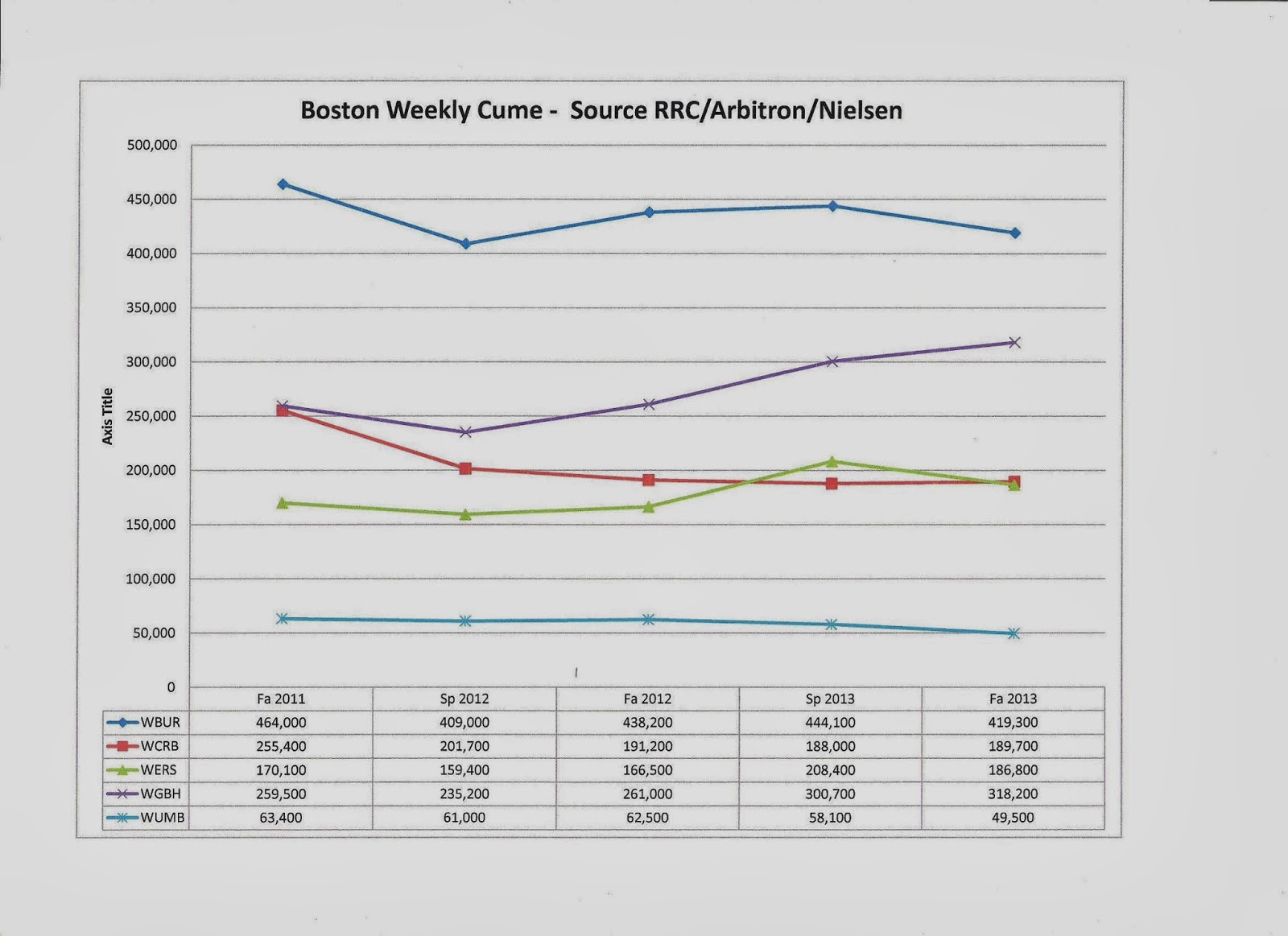
It has been over two years since the change. Enough time has elapsed to get an idea of audience trends. The results are mixed. WGBH is showing growth. WCRB (the station with the weaker signal) is not showing growth.  Looking at topline figures for five public radio stations using Fall and Spring Quarter data starting with the Fall Quarter from 2011 to the present you can get a sense of where things have gone in Boston. WBUR is holding onto its share of the Boston audience. WGBH is growing its average audience, share and cume. WCRB is declining in all three metrics. WERS, with its eclectic music programming, has a large weekly cume but, they have a very high turnover ratio. WUMB continues to bump against the bottom. Whatever they're doing isn't having much of an effect on the audience. I worked at WUMB for a short while at the end of 2010 and the start of 2011. Audience figures are pretty much the same as they were back then.

WGBH saw the need for change. Despite criticism and negative feedback, they are beginning to see postive results.

Steel Yourself
Change is something I'm familiar with. I helped shepherd two changes at WNPR. The first came in 1989 when WNPR took control of its programming in the morning. The phone calls and letters from contributors were sharply critical. The press was negative. Letters to the editor ran heavily against the changes. The results were positive with growth in audience and member dollars. In 2006, when the format changed to include more news and information, the feedback was more intense. The Hartford Courant devoted a front page article with a banner headline to the change. The article was not positive. It lamented the loss of classical music and, at the same time, included a sidebar with a list of eight other stations in the market that still carried the genre. Over 4,000 complaints came in from members. Major donors were bending the ear of the CEO. He had his doubts about the change from the beginning. The complaints reinforced his doubts.

Before the change we did our homework. We measured the effects the change would have on our membership by splitting them into groups called imperatives. They were News Imperatives, Crossover Imperatives, and Classical Imperatives. In our survey, we paid particular attention to what would happen to the Crossover Imperative. We already knew the News Imperatives would be supportive. And, we knew the Classical Imperatives would leave us. The question was, "Would the Crossover Imperatives remain in sufficient numbers to sustain our membership dollars over the short term?” The answer seemed to be yes. Still, there was some uncertainty. When contemplating the change it is important to understand that the reaction from many contributors will be negative. They contribute because they like the station the way it is.

It takes courage to make changes in public radio. The onslaught of complaints wilted some including senior management.  My performance review that first year was blistering.

A Positive Outcome
In the first year our audience grew and became more loyal. Membership dollars remained stable. The number of members decreased slightly. Our corporate and foundation support grew 500 percent!

Contemplating change? It takes research, planning and courage.

In the end, the Boston market may be robust enough to support competition for the Public Radio Audience.

The data below is from RRC, Arbitron and Nielsen. I've used AQH Persons, AQH Share and Weekly Cume to give a sense of the trends.


Friday, October 14, 2011

Web Content

I'm a proponent of putting public radio content on the station Website...first. 
There...I feel better already for admitting it. Many listeners are getting news on-line. They're not waiting for the hard structures of the newscast deadline. Once a feature is finished why not post it? You don't have to wait for an airing to try to push listeners to your Website. 


For some stations with the resources there's web only content.


There are two examples of Web only content this week. The most prominent is the announcement out of WNYC that Alec Baldwin will be posting 20 podcasts over the next several months called, Here’s the Thing.” According to a New York Times Blog by Dave Itzkoff and WNYC the interviews will allow Mr. Baldwin to “pursue his passions and interests through conversations with a variety of news makers, artists, actors, writers and public figures who spark his fancy.” There are tentative plans to make the podcasts into radio programs with additional  content from other producers.


The second example is from WBUR in Boston. WBUR and reporter Martha Bebinger launched Healthcare Savvy, an online community of patients who are starting to shop for health care based on quality and cost. It's and example of crowd sourcing information. Healthcare Savvy has more than 150 members. It's a mix of patient and healthcare providers. According to Amanda Hirsch of PBS' Media ShiftHealthcare Savvy was born to provide a space for discussion as well as a compendium of resources on health costs.  The project is funded in part by the California Endowment Health Journalism Fellowships, a program of the University of Southern California's Annenberg School for Communication and Journalism.

Monday, August 22, 2011

WBUR/WGBH Revisited

WGBH and WBUR continue to compete for the same market share...the NPR news listener. It was feared when WGBH switched formats to News and information that the move would split the audience. It hasn't quite turned out that way.

Certainly WBUR lost share of the market while WGBH made very modest gains. More importantly, public radio collectively lost share of the Boston Market. Public Radio's Share of the market, (Persons 6+) according to PPM data provided by RRC, has dropped from 9.5% to 7.0% of the radio audience.


I compared the quarterly topline reports from Winter 2010 to Spring 2011.
Without more data, I can only guess at what is happening. It seems public radio is less appealing now to the Boston Market than it was in the Winter of 2010.


Monday, April 25, 2011

WBUR - Feeling the sting of competition Part Two

WGBH changes sting public radio rival - The Boston Globe

One of the things we used to talk about was that having more stations below 92 on the dial would raise all boats. That is, if there were more stations carrying NPR content, more listeners would come to public radio.

My question - are more listeners coming to public radio after the switch by WGBH to NPR news/talk? I cannot give you public radio's total Cume audience. I can give you public radio's share over time.


Based on topline figures the trend line shows public radio's share of the market is decreasing. WGBH's trend line is slightly upward. WBUR's trend line shows they have lost about a half point.  Average audience for public radio is also declining. Declines in share and average audience for WBUR may be due in part to increased competition between WGBH and WBUR. Another factor is a decline in Public Radio's share of the radio market. Decreased listening to public radio in the Boston market is contributing to WBUR's decline.


One more thing to consider.  The starting point...the month WGBH switched formats...may be skewed. The increased attention brought on by the publicity may have inflated the number of listeners sampling public radio. Eliminating December 2009 from the chart slightly lessens the decreasing trends for public radio and for WBUR, but not entirely.


Sunday, April 24, 2011

WGBH changes sting public radio rival - The Boston Globe

WGBH changes sting public radio rival - The Boston Globe

I'm bothered by the horse race aspect of this article.

Here's why:
A weakness of the month to month system employed by Arbitron with PPM is the volatility of the numbers. To be sure, they are more reliable than the diary numbers. Still, there is a certain amount of bounce in the estimates from month to month. 


Using trends is much more reliable. The six month average in The Vital Signs Report available to public radio stations by RRC offers even more reliability.

Trending average audience share figures from Arbitron 6+ PPM Metro Boston show modest gains for WGBH in the past six months. WBUR's trend is flat. The other major player among public radio stations in Boston,WCRB, is trending downward.

The numbers being used are for Boston Metro and do not reflect the audience estimates for WGBH and WBUR outside the Boston Metro Market.


            Nov 10  Dec 10  Hol 10  Jan 10  Feb 10 Mar 10 
 WBUR 3.9%     3.5%     3.1%    4.0%    3.7%    3.6% 
 WCRB 2.4%     2.2%     2.9%    2.4%    1.9%    2.1% 
 WGBH 1.5%    1.4%      1.2%   1.7%     1.6%    1.4%  

Saturday, December 11, 2010

WBUR’s new ad campaign is a rarity for public radio - The Boston Globe

WBUR’s new ad campaign is a rarity for public radio - The Boston Globe

The competition for public radio's news audience continues in Boston. WBUR has a new billboard campaign. WGBH has the ability to cross promote with it's other radio stations and it's public TV station. So, how is it going? "Last month, WBUR drew a weekly audience of 455,400 listeners to its daytime programming, while WGBH attracted 258,900 listeners."


Billboard campaigns for public radio in the past have had mixed results. Certainly, they increase awareness. In my experience, there has been little evidence of audience growth as a result of the campaigns I've been involved with.

Check out the article by Johhny Diaz in the Boston Globe from December 11, 2010.

Sunday, June 27, 2010

After format swap, WGBH lags behind WBUR in ratings

After format swap, WGBH lags behind WBUR in ratings
Found in the Boston Herald.com by Jessica Heslam.

The 1.0 share for WGBH has to be disappointing. It is not the end of the world.
There are two great comments that put this into perspective.

Boston radio consultant and Lesley University professor Donna Halper said this is a marathon - not a sprint. “I’ve been consulting for 30 years and there is no history of a talk radio format, particularly on public broadcasting, storming in and taking over the world,” Halper said.

While WBUR has WGBH beat so far, Fleming said his station is still concerned about the newcomer, but it’s forced them to “focus in on what we do well.”

If this is going to work for WGBH, they will need to take the long view. The news is not so bad for their classical service. WCRB has 2.2 share in April and a 2.6 share for the winter quarter according to Arbitron and the Radio Research Consortium.


Saturday, April 17, 2010

Overlapping news programs blur line between WBUR and WGBH - The Boston Globe

There's an interesting article in the Boston Globe by Johnny Diaz about the efforts WBUR and WGBH are making to differentiate themselves from each other. There's anecdotal evidence in the article about listener dissatisfaction with duplication of programming. (There's more of that in the comments section.)

It's way too soon to tell how this will shake out. The audience figures in the article represent listening for one month. More significant will be the one year trends in Average Persons and AQH Share. Plus, a look at the changing dynamics of crossover and shared audience, after a year, will give more insight into blurring distinctions.

Overlapping news programs blur line between WBUR, WGBH radio stations - The Boston Globe

Posted using ShareThis

Wednesday, April 14, 2010

WBUR Auction Goes Green


Newton Solar Company is helping WBUR raise funds by offering two solar units for it's silent auction. The donation seems like a perfect fit for WBUR's. According to the release from The Daily News Tribune the contribution is a  nod to the green-mindedness of WBUR's listeners.It's a good partnership because it will also raise awareness for Newton Solar Company. 


The silent auction will be held Monday, June 7, at the State Room in downtown Boston. Past auctions have included items like lunch with Click and Clack, Trips to Greece and the island of St. Barthelemy, and tickets to the Red Sox with seats in the GM's box. 

Auctions won't replace the on-air drive, but they do promote some high-end giving.

Wednesday, December 23, 2009

WGBH Changes Leads to Dissent


The negative blow-back that WGBH is getting from listeners about the recent program changes is to be expected. In a way we in public media enable a sense of ownership over the programming through our membership campaigns. We ask listeners to become activists when we ask for their support, and they become invested. Despite the fact that ratings, loyalty figures and support dollars may be below what is needed to sustain programming, there those who did invest who will feel alienated by the changes.

Take a look at the article from the Boston Herald By Daniel Gerwetz and then drop down to the comments. Recent changes at KUT in Austin and WDET in Detroit have led to similar protests.
You can make changes for all the right reasons, but for some listeners those reasons won't matter. They're felling a sense of loss and betrayal. Management and the major stakeholders need to be prepared and be able to weather the storm.

To be sure there are other issues surrounding the changes made by WGBH. Not the least of which is the question; is there room for two public radio news and information stations in the Boston market. WBUR is well established as the NPR news station. WBUR's ratings are four times that of WGBH according to the Herald article. WCRB's ratings were three times that of WGBH. That made their NPR news service and classical music service second choice among both audiences. Being second choice directly affects the stations ability to raise listener sensitive income. In a down economy difficulty raising listener support is not a comfortable position to be in.