Showing posts with label wnpr. Show all posts

Sunday, September 3, 2017

Farewell Car Talk

The Best of Car Talk is going off the air at the end of September. 


Car Talk began recycling old material starting in 2012 when Tom could no longer participate in the show. Tom Magliozzi sadly passed away two years later. Without fresh material, it was only a matter of time before the show would end its run.

30 years is an amazing run. During the height of it's popularity on WNPR, Car Talk and Wait, Wait combined for the station's largest Average Quarter Hour Audience. Fundraising during that block of time was incredible.

One station, WPLN, is engaging its listeners with an invitation to share favorite memories of the show. That seems like a great way to engage listeners who have been faithful to Car Talk for years. The stations within earshot for me have not announced anything yet.

My question: Is it better to let the program slip away quietly, or acknowledge the place Car Talk has in minds of its many fans?

By letting it go, are you missing an opportunity to engage your listeners?

Thoughts?

Monday, September 12, 2016

Podcast Income

Can Podcasts be a source of income for public radio? From a station's perspective...Yes ...as long as expectations aren't too high.

There are three sources of income for public radio. Member Support - Underwriting - Grants. Listener support for podcasts has lagged. Is that changing?

The headline reads...WNYC boosts podcast income with text-to-donate efforts...which is a little misleading. Digging deeper into the article in Current you will find that the amounts are small ($10), and there's no way to mine the data for follow-up information.

Voluntary Support

Does this mean the experiment is a failure? No! It means there is the possibility stations could cover the cost of podcasts, and WNYC is continuing the experiment to find ways to continue the funding discussion with text-to-donate contributors. The willingness of podcast users to voluntarily contribute for the content they consume is a hopeful sign. Obviously, not everybody is willing to pay, but how is that different from the current membership model?

WNPR experimented with a text-to-donate fundrive in 2008. The sames issues arose. The donation amounts were small and the link between the donation and the donor was non-existent. WNPR's text to donate drive differed in that we used the airwaves to generate texts. The pitch breaks were short and the number of breaks were limited. We got about 100 texts and about $1,000.

Self Sustaining?

Given the huge demand for revenue to operate a public radio station, there was no follow-up on the project at WNPR. If the funding source is viewed as an additional revenue stream related to a separate platform, expectations might be more in line with reality. The other challenge is to convert the podcast cohort into public radio supporters. At least text to donate is a beginning. When combined with other sources like grants, advertising and pay walls, some podcasts could pay for themselves.

The Funding Trifecta

The renewal of grants depends on meeting stated expectations. The same could be said for advertising. As long as the podcast delivers an audience, the revenue will continue to come in. The public radio funding model has always been sustained by voluntary contributions. The most stable source of income for public broadcasters has always been its donors. If the other two sources lagged (grants and underwriting), contributions offered stability. The success of podcasts in public media will be measured by their appeal to the audience.

Wednesday, March 30, 2016

Covering Issues and Ideas

Transcending Geography

This article is not about local vs national coverage. It is about getting the most out of what stations can offer locally. Thinking about coverage from the perspective of the listener will help guide the focus of your content. It is an argument I made for years in music programming. It is an argument that often fell on deaf ears. That is, until we found ourselves creating barriers between our programming and the audience we were hoping to serve. Change came about slowly, but I like to think at WNPR we learned our lesson. It bears repeating.


Users of public media transcend local. Research I was a part of at Connecticut Public Broadcasting demonstrated clearly the world perspective public radio listeners have. This worldly view is not just a phenomenon in Connecticut. Broader research conducted for the public radio system through The Corporation for Public Broadcasting (CPB), The Public Radio Program Directors Association (PRPD) and others demonstrated the preference of public media users to look at issues from a broader perspective. The Sense of Place Study clearly pointed out that local coverage for the sake of being local was not an effective use of the media's resources.

Covering Issues

At WNPR we decided in 2006 when looking at format change to look at the issues and ideas that defined where we live rather than geography. Part of reason was pragmatic. Connecticut is governed by over 160 town governments. The attitude in Connecticut is that the issues in Hamden have no relationship to the issues in Waterbury. Or, that's in Hartford...not here. The thinking in the system at the time was to center coverage on a region like Chicago, New York or the Twin Cities. Connecticut did not have a regional center. Focusing on one area would make WNPR local and irrelevant to much of the state.. We decided to look at issues and ideas from a much broader perspective.

Others are taking this approach. WAMU recently announced they would realign their news coverage to key issues rather than geography. The key areas of their coverage will be Transportation and Development, Education and Inequality, Race and Ethnicity, Power and Influence, and Arts and Culture.

WUWM in Milwaukee is also covering news from an issues perspective. The news drop down  menu on  their website reveals coverage in the Environment, Economy & Business, Politics & Government, Education, Health & Science, World, Arts & Culture, and Project Milwaukee. Station Manager Dave Edwards mentioned that this approach is working out well for his station.

A Lucrative Decision

The decision at WNPR to focus on issues and ideas proved beneficial to the audience and the station. Increases in audience and loyalty followed. The launch of Where We Live by a very talented staff highlighted and enhanced coverage engaging the stations audience, Opportunities to develop partnerships in the community followed and so do did funding opportunities.

A Collaborative Effort

CPB announced in February a collaboration they are funding for regional coverage among several stations in New England. The geographic coverage will focus on issues and ideas. According to a release from Vermont Public Radio, "The New England News Collaborative (NENC) will produce multimedia coverage focusing on the region's energy usage, climate, transportation infrastructure, and its people and immigration issues. This robust partnership will produce dynamic reporting projects for on-air broadcast, digital and web presentations, and a series of public Town Hall-style meetings centered on issues facing New England and its residents."

WNPR will run the collaboration which will depend on the talents of reporters and producers across the New England states. The stations involved in the project are Connecticut Public Broadcasting Network, WBUR,Maine Public Broadcasting Network, New Hampshire Public Radio, Vermont Public Radio, New England Public Radio, Rhode Island Public Radio, and WSHU Public Radio.

Beyond Seed Money

The ability of the stations to keep the project going after the grant runs its course will depend on how willing they are to play nicely with each other. Certainly, the coverage will present opportunities for growth on all platforms. It will be up to the station to use the content to leverage partnerships and funding opportunities and put that revenue back into the partnership. It can work. 

Sunday, December 13, 2015

Podcasts - The New VHS?

I struggled with the conclusion of this blog. I am not against podcasts or progress or new platforms. It's more about collecting and saving content that I may get to later. For me...later never seems to happen.

Digital Clutter

I was sorting through some of our stuff. Actually, I was looking for things to toss and I came across some VHS tapes. None of them have been watched. It looks as if I will never watch them for two reasons.
  1. I no longer have a player
  2. I'm no longer interested.
I'll save one tape. I contains video of my son when he was two. The rest is just trash.

I recently read articles about the generational divide for public radio and NPR. So...are podcasts the saving grace? The line that stood out was that there is no way to measure if all those downloaded podcasts are actually being listened to. Time Spent Listening for radio can be measured, but there's no way to determined of listeners are actually listening the content on podcasts. 

This is an important issue when it comes to building audience and loyalty. Marketing and development becomes more effective when positive outcomes from a listeners perspective can be demonstrated to the potential funder or contributor. Money follows audience.

I'm curious. How many podcasts are just taking up space on your device? How many do you actually listen to? Is there a way this could be measured? Opened emails can be measured with an email service. Analytics can show information about time spent on a blog site and website. Even the number of clicks on a page can be measured. Once a podcast is downloaded, what happens to the podcast is not traceable. Wouldn't it be nice if we could track actual usage for podcasts?


No Critical Mass?

But, are the numbers big enough to really matter? Serial is considered a breakout hit for podcasts. There were over 40 million downloads. It is estimated that each episode was downloaded 3.4 million times. Unfortunately, most podcasts don't come anywhere close to those numbers. Compare that with the weekly cume of the public radio station I listen to most. WNPR has over 200,000 listeners weekly. The weekly cume for public radio is 30 million. That's an unduplicated cume. I'm not sure, but the unduplicated weekly cume for Serial was 3.4 million. Cume is not the critical number when it comes to funding...the core audience is. Perhaps, if we could figure out the podcast's core?

I think the question is moot. Podcast's may be suited for the younger demographics of public radio's potential audience, but they may not be suitable for broadcast. Radio works best when it has a consistent audience appeal. You can tune in anytime and get what you want. It does not work well as a venue for appointment listening. Podcasts are all about appointments (so were VHS tapes).  The best part is the technology allows the user to make the appointment. We can make certain aspects of public radio programming available for on-demand listening and use social media to try to create a viral buzz, but as with most podcasts, don't expect the response and buzz that was created by Serial.

Saturday, April 4, 2015

What are the top of mind issues for your audience?

Eye Off The Ball?


Issues like Right to Work, Hilary Clinton's Email and Religious Freedom Restoration Act (RFRA) generate a lot of heat, but they may be beside the point. The South Central Federation of Labor in Wisconsin polled a wide variety of Wisconsinites including middle class, working class, small business owners, people with jobs and the unemployed. They wanted to measure the importance of the "Right to Work Bill" to Wisconsinites.

Right to Work did not make the cut. What Did?
  • Raising wages
  • Maintaining quality schools
  • Basic community improvements
  • Job training opportunities
  • More affordable education
  • Good housing
What would have more impact in news coverage? What would make for positive outcomes? What coverage would engage the community? The six points above would have a meaningful effect on the community. Or, do we let others set the agenda? 

RFRA, Hilary's email and Right to Work certainly merit coverage, but balance is needed. I think it is important to cover the issues that resonate with the community. It is important to cover what really matters. Reporting on the issues resonate with the news consumer's values will have a lasting effect. And, think about how issues like "Right to Work" can be seen through a much broader and impactful lens like good jobs, job training, increasing incomes, etc. Talk with people in other parts of the country about what has worked and what has not worked after "Right to Work" laws have been enacted in other parts of the country.

When we launched "Where We Live" at WNPR we asked ourselves, What are the key issues that define Connecticut? We came up with a list of six. The issues have been redefined and refined since the launch in 2006, but talking about issues that resonate with the audience is key to the success of the program and the station.


Thursday, February 19, 2015

Ebbing Loyalty


Image result for on point

Straight to the Source

Earlier today, I wanted to listen in to the debate about Scott Walker's proposed cuts to the University of Wisconsin System. WBUR's On-Point put together a program about the cuts with several guests including:
  • Karen Herzog, higher education reporter for the Milwaukee Journal Sentinel. (@herzogjs)
  • Noel Radomski, director of the Wisconsin Center for the Advancement of Postsecondary Education. (@noelradomski)
  • Christian Schneidercolumnist at the Milwaukee Journal Sentinel. (@schneider_cm)
  • John Sharpless, professor of history at the University of Wisconsin, Madison. Republican candidate for the United States House of Representatives from Wisconsin’s Second Congressional District in 2000.

Convenient Listening

I used to work at WNPR in Connecticut. I still live in their listening area. You would think I have a certain amount of loyalty to the station. Despite my layoff from WNPR in 2009, I still help them raise money during pledge. I still listen while driving. But now, I hardly ever listen at home. Instead of listening to the feed from WNPR, I chose to listen to the feed from WBUR. I went directly to the source. 

Since I was unable to catch the program from the start (I listened on-line about half-way into the program), I will listen to the first half of the program later through the On-Point web page. It's a lot more convenient.

Loyalty

Does this mean I'm less loyal to WNPR?  It does! Here's how the Radio Research Consortium looks at Loyalty.
Loyalty is the total QHs of listening to your station expressed as a percentage of all QHs of listening to radio in your listeners’ diaries. It is a measure of how well (or how poorly) your programming elicits listening by your cume. Here is how to interpret this Loyalty rate: Of all the quarter-hours of listening to radio over the entire survey week by your 106,700 metro area cume persons, 37.1% of those QHs were spent with WRRCFM. The audience is 37.1% loyal to the station. What does the level of loyalty indicate? Low loyalty suggests you may be trying to serve too many constituencies. High loyalty, but low cume says you are superserving too small a target audience. High loyalty and high cume means you are doing a good job of bringing people in and keeping them involved with the station.
My loyalty may actually be the same. The percent of Quarter Hours devoted to WNPR might still be the same as before, but my listening to radio is less than it once was. The total number of Quarter Hours is a lot less than it was ten years ago. I still I listen to WNPR 50% of the time...that share of pie is still the same, but the pie is smaller.

Image result for wnprDoes this Matter?  

Loyalty is important when it comes to fundraising. So is the number of Occasions. My total listening time is down.  The more loyal I am as a listener to a public radio station...the more likely I am to contribute. My time spent listening matters to. As I spend less time listening...My willingness to contribute diminishes.        

AQH Persons

A way stations can determine if listeners are spending less time with their programming is to look at Time Spent Listening and the Average Quarter Hour Audience. For this example, I did for WNPR. In the past two years AQH is down 29% and TSL is down 19% in the Hartford Metro Area. The trend suggests it will be harder for WNPR to raise money from listeners. John Sutton from RadioSutton, a Public Media consultant, suggests that reductions in AQH require stations to use more leverage during fundraisers to meet their goals. For more information on the use of leverage, please read, "It’s Taking More Leverage to Generate Pledge Drive Contributions."

What's Next?

WNPR can help itself. It can make sure they are making the most of forward promotion opportunities. They can also carefully examine the appeal of its programming. They can look at which programming elements are drawing audience and which are not. WNPR can also realign resources to programming that defines their audience. They can then determine where changes are needed. They can also make sure they have a robust on-line and social media presence. I will need reasons to listen to their content on-line and on-demand. If they can do all that, they might be able to get me to spend more time listening to their content. By doing that, my time spent listening to their content will rise.


Thursday, November 13, 2014

Car Talk Regrets

The Story Ended Happily


John Dankosky's Blog about Tom Magliozzi (Why Everyone Who Loves Public Radio Should Thank Tom Magliozzi) reminds of the time I decided to take Car Talk off the air. We had a classical music audience. The phone calls about the show were hostile...vehement. Based on those calls and the urging of the station manager I pulled the plug. It was a big mistake. I learned a lesson about programming by phone call. The caller represents his or her interest...nothing more. Audience figures over the next six months convinced me I made a mistake. Our Saturday morning audience went to our public radio competitors. Fund raising took a big hit. Within a year Car Talk was back. The program was welcomed back in a big way with a huge audience and blockbuster fundraising as described by John in his blog posting. I've been told the audience for Car Talk continues to be strong.

Community of Listeners

Reinstating Car Talk was the the impetus for the gathering of the public radio community. That community is one of the key concepts of the Audience '98 research project.
                  A Sense of Community

If givers think of public radio as a community, then a fund drive is a barn raising, not the Home Shopping Network. On-air pitching is passing the hat, not selling Beanie Babies. Shirts and mugs – still the most popular premiums – are emblems of membership and pride in the community, not merchandise exchanged for cash.

"Sense of community" may add dimension to the seminal concept of personal importance, and thereby help public radio professionals to influence giving, focus fundraising messages, and schedule programming. 
Communication technologies let us choose our neighbors based on their sympathies rather than their proximities. Being connected to other people by psychological rather than geographical space isn't so alien anymore.

Audience loyalty and support grew by leaps and bounds after Car Talk found a permanent place on WNPR's schedule on Saturday Morning. It was as if we had crossed a threshold of Core Listening. A solid base of support resulted. Radio at Connecticut Public Broadcasting became self sustaining.

If that sense of community disappears...Public Radio will become a memory.

Saturday, October 11, 2014

Why We Give: Generosity and Public Radio

It's Not About the Mug

I sat in at my local public radio station this week asking for contributions. By public radio standards it was a huge success. During Morning Edition we went over goal by 25%. We didn't have a drawing. We didn't have a challenge grant. We had thank you gifts, and for many, that can become the main focus of their pitch. But that wasn't ours. We took it in a different direction.

Pledge Drift

There was a risk in doing it this way. Response has been good to the request for funds based on pledging tied to thank you gifts. At least the focus of the pledge is on something the listener might want. Selling logo'd items can generate a response. Selling books that are the subject of an interview can generate response too. I have several public radio mugs in my collection.  Still, thank you gifts don't get to the reason why people listen or give. Giving is tied to listening and loyalty. Once you've got them listening several times a week, you have a better chance the listener will become a supporter. 


Feeling Good

I applied articles I've been researching  on what works. Some of the answers can be found in previous blogs,Why We Give and Why We Give - It Makes us Feel Good.  People responded best when the request is taken to a personal level. When we shared experiences and stories from listeners, we got response. We told their stories.
 
Coming up with the stories was easy. I simply asked the listeners to give me a reason why they find WNPR to be so valuable. Why are they listening? Are there programs they find important? Is there a memorable moment they want to share to inspire others to give?  Most of the comments were a line or two. All of the stories were something the listener could relate to.
 
I still included the facts and figures and the thank you gifts, but the compelling stuff was in the listeners' responses. The focus was on the listener, not on WNPR’s needs. It was a success. We exceeded our goals that morning by 25%.

Caution - Contents are Hot

coffee  Free PhotoThe key to this approach is the loyalty and the size of the P1 audience has towards the content. If a programming segment has high listener loyalty, the approach is likely to work. If the loyalty is lower, other factors like gifts need to be employed. When I worked in Milwaukee, we could not generate many calls of support during classical music unless there was a premium tied to the pitch. Perhaps the content was not all that compelling. Compelling and well-crafted content always makes the job of the fundraiser easier.


Thursday, July 31, 2014

WNPR's Neighbor Sold

WCCC...WNPR's next door neighbor...is being sold to a Christian Broadcaster. You could see WCCC from the newsroom. WCCC's Brat Fest will be missed.

Word was Connecticut Public Broadcasting wanted to buy WCCC, but was unable to pull off the deal.

EMF Broadcasting will be acquiring the station to add it to its Christian AC “K-Love” network. K-Love has over 440 stations and translators nationwide. The audience is estimated to be about 12 million. The primary format focus is Contemporary Christian Music. This represents a new format for the Hartford Market. There is a LPFM (Mom and Pop) serving parts of the market. WCCC will provide full coverage.

Read more at: http://radioinsight.com/blog/headlines/89584/wccc-fm-hartford-to-be-sold/

Tuesday, February 18, 2014

Some Things Never Change

WGBH Shows Growth
In 2011, when WGBH made changes, they were roundly criticized. At the end of 2011 WGBH split off its news service and created a separate classical and music service on WCRB. There were loud complaints from WBUR about diluting the NPR news audience. There were complaints from long-time classical listeners. WCRB's signal was much weaker than WGBH's. Many in the system doubted WGBH's move, wondering if the news market in Boston could support two NPR stations. For its part, WGBH came to the conclusion they could no longer be a viable public media operation being all things to all people on one signal.

So what happened? Early results were not encouraging. Audience figures did not show growth. Despite the fact that looking at early results is unreliable, many thought it proved the point that WGBH had made a huge mistake.

Taking the Long View
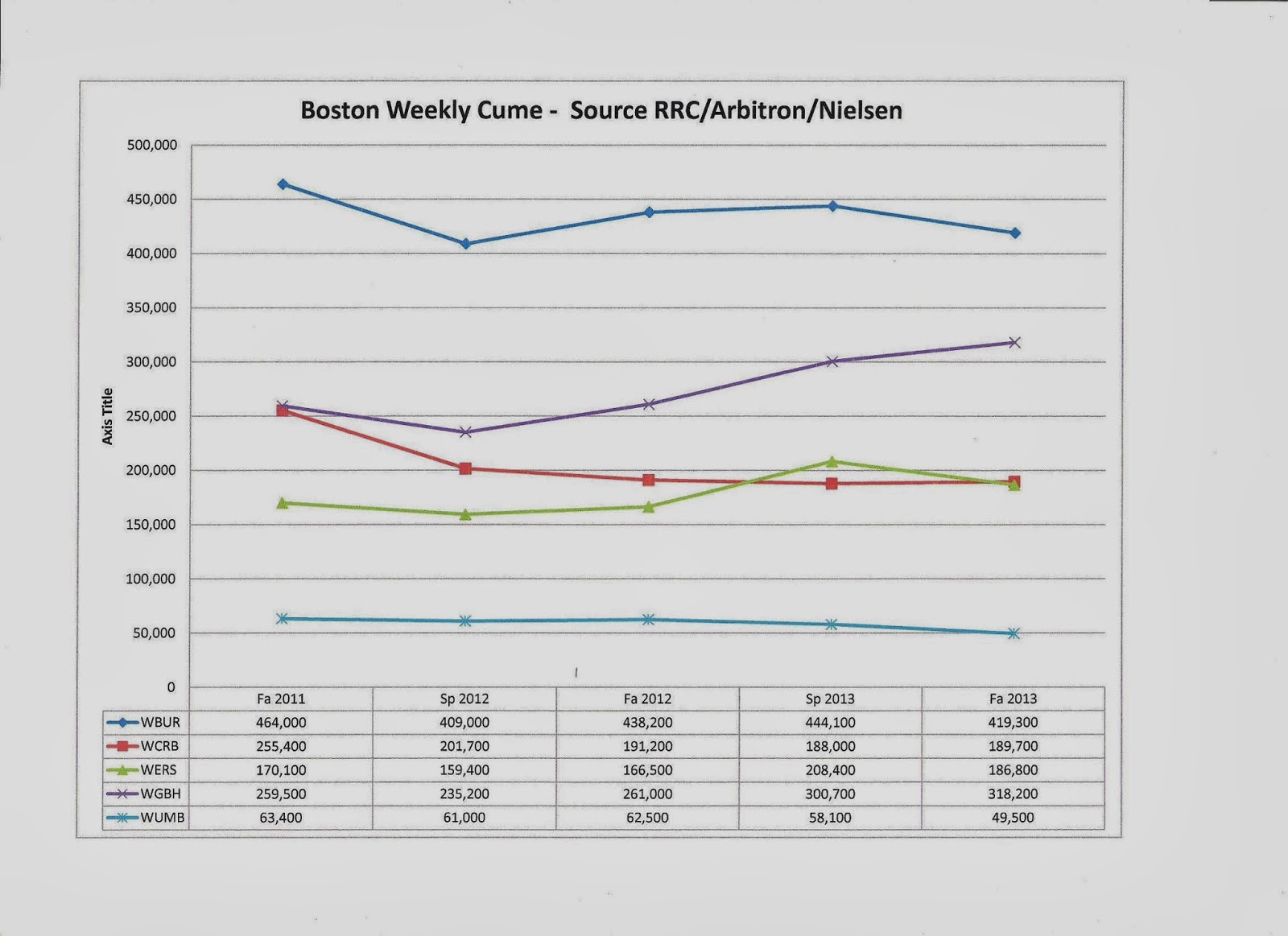
It has been over two years since the change. Enough time has elapsed to get an idea of audience trends. The results are mixed. WGBH is showing growth. WCRB (the station with the weaker signal) is not showing growth.  Looking at topline figures for five public radio stations using Fall and Spring Quarter data starting with the Fall Quarter from 2011 to the present you can get a sense of where things have gone in Boston. WBUR is holding onto its share of the Boston audience. WGBH is growing its average audience, share and cume. WCRB is declining in all three metrics. WERS, with its eclectic music programming, has a large weekly cume but, they have a very high turnover ratio. WUMB continues to bump against the bottom. Whatever they're doing isn't having much of an effect on the audience. I worked at WUMB for a short while at the end of 2010 and the start of 2011. Audience figures are pretty much the same as they were back then.

WGBH saw the need for change. Despite criticism and negative feedback, they are beginning to see postive results.

Steel Yourself
Change is something I'm familiar with. I helped shepherd two changes at WNPR. The first came in 1989 when WNPR took control of its programming in the morning. The phone calls and letters from contributors were sharply critical. The press was negative. Letters to the editor ran heavily against the changes. The results were positive with growth in audience and member dollars. In 2006, when the format changed to include more news and information, the feedback was more intense. The Hartford Courant devoted a front page article with a banner headline to the change. The article was not positive. It lamented the loss of classical music and, at the same time, included a sidebar with a list of eight other stations in the market that still carried the genre. Over 4,000 complaints came in from members. Major donors were bending the ear of the CEO. He had his doubts about the change from the beginning. The complaints reinforced his doubts.

Before the change we did our homework. We measured the effects the change would have on our membership by splitting them into groups called imperatives. They were News Imperatives, Crossover Imperatives, and Classical Imperatives. In our survey, we paid particular attention to what would happen to the Crossover Imperative. We already knew the News Imperatives would be supportive. And, we knew the Classical Imperatives would leave us. The question was, "Would the Crossover Imperatives remain in sufficient numbers to sustain our membership dollars over the short term?” The answer seemed to be yes. Still, there was some uncertainty. When contemplating the change it is important to understand that the reaction from many contributors will be negative. They contribute because they like the station the way it is.

It takes courage to make changes in public radio. The onslaught of complaints wilted some including senior management.  My performance review that first year was blistering.

A Positive Outcome
In the first year our audience grew and became more loyal. Membership dollars remained stable. The number of members decreased slightly. Our corporate and foundation support grew 500 percent!

Contemplating change? It takes research, planning and courage.

In the end, the Boston market may be robust enough to support competition for the Public Radio Audience.

The data below is from RRC, Arbitron and Nielsen. I've used AQH Persons, AQH Share and Weekly Cume to give a sense of the trends.


Monday, November 4, 2013

Recurring Fundraising Dream

There was a time when I was responsible for the fund drives at WNPR. That continued even after Connecticut Public Broadcasting united donor development into one department. The fund raiser became a partnership...a collaboration.

Dreaming about Fund Drives
Just before every drive I had a recurring dream. In that dream nobody called. Since I was also responsible for content, the dream also meant that my choices for programming had no appeal to the audience. The axiom of "Significant Programming for a Significant Audience" proved false. The implications of the dream was that the programming was not significant and the audience it generated was not interested in voluntarily supporting the programming. The dream never came true. I worked with some talented content people who worked hard at programming that appealed to a significant audience.

There were ways of measuring what we were doing that helped predict what areas of our scheduled would be successful during the fund drive and what areas would be more difficult. I wrote a couple of articles with the help of the folks at Audience Research Analysis for Audience 98. You can read about it. Public Service Economics and Connecticut Public Radio By The Numbers. It's public radio geek. When I presented this stuff to upper management and the board, their eyes glazed over. They didn't get it. Because of the time put into the research, because we did our homework trying to understand how the audience used the content, the bad dream never came true.

That Same Old Feeling
I'm experiencing some of the same foreboding. We're about to launch an appeal for donations for the FOCUS Center for Autism. I'm working for them as Development and Marketing Coordinator. The audience is much smaller but, the content is significant and meaningful. FOCUS Center for Autism became a non-profit organization in 2000 under the name of FOCUS Alternative Learning Center. What began in 1996 as an after-school program and a camp in the summers for children and adolescents on the Autism Spectrum is now an intensive and growing clinical continuum of care. In 2009 we expanded our Extended Day Treatment Program to include the morning hours and to offer a Clinical Education Program that targets children who are having a difficult experience in their traditional school system. This program coupled with our After School Program offers a comprehensive clinical model that promotes social, emotional and academic growth. The FOCUS Extended Day Treatment Program has developed into a well respected community-based model of treatment that has now served over 500 children and families.

The challenge is getting the word out to a much smaller audience.


Saturday, September 21, 2013

WNPR.ORG coming back Updated

This is long overdue. Wnpr.org was supplanted a few years ago by yourpublicmedia.org in an effort to create a more robust news website. WNPR took a risk when they did this. The move abandoned a really effective branding...WNPR. It also led to confusion. They were always talking about two websites and one of them took the listener away from WNPR. When the change was made it was deemed necessary because the experience of navigating through the CPBN site was frustrating. Unfortunately the move to yourpublicmedia.org left listeners confused. The question was...are you WNPR or are you Your Public Media?

Why did the change fail? I think the motivation for the change was internally driven. It was not driven by the user experience. To make things worse, the partnerships developed with yourpublicmedia never really evolved. It was always hard to find WNPR's content on the site. At least from my perspective, the user experience was frustrating when trying to find stories aired on WNPR. I gave up.

Now all they have to do is find the resources needed to keep the site updated and relevant.

Wednesday, July 10, 2013

Focus on local


You know what I miss about the Real Life Survival Guide? It was its focus on local. We met in locally owned businesses with strong community roots. That focus of the program was important. It generated a sense of community among the guests and was demonstrated by the places we met. What brought this to mind was a program on WNPR's Where We Live about the preponderance of big box stores.

Some examples of the connections we made include:

There were 72 episodes. For the most part in locally owned establishments in and around New Haven.

The big box stores? I go there. I try to be pleasant to the staff. I'm guessing from their expressions, most people are not trying to engage them in a pleasant way. But, it is not the same as going to a place "where everybody knows your name." When I was growing up we had local businesses where we did business. There was a local TV repairman, local restaurants (a rotation of about five), a regular barber, a particular clothing store, an auto mechanic, a bike shop, a local grocer even a car dealership and many others we had relationships with. They knew us. They helped us based on our relationship and we trusted them. We don't have as many of those relationships anymore. I miss the sense of community.


Thursday, June 27, 2013

TOTN Departs - Changes at WNPR

WNPR announced several program changes today. Among those changes is a scaling back of one of WNPR's longstanding local programs.

Here's what was in the announcement:

Dear Mr. Grehn,

As Talk of the Nation signs off the air today for the last time, I want to let you know about some schedule changes.
Here & Now debuts on WNPR on July 1 at 2 p.m. (The program will air Mondays through Thursdays at 2 p.m.). Here & Now is a daily news magazine which aims to guide us through the streams of news and information. Learn more about hosts Robin Young and Jeremy Hobson below. Here & Now hosts
A regular presence on WNPR for 33 years, the Peabody-award-winning Faith Middleton Show will air at 3 p.m., Monday through Thursday. The Food Schmooze remains in its regular spot on Wednesdays at 3 p.m. with a repeat on Saturdays at noon.
Faith MiddletonCredit: Heather Colt
Starting Friday, July 5, Science Friday will expand to include the entire 2 hours. Hosted by Ira Flatow, Science Friday focuses on science topics in the news and features discussions. It will air from 2– 4 p.m.
Ira Flatow
This is just the beginning; we have some significant service changes lined up that we hope will enrich WNPR for our listeners. Stay tuned for additional updates – including the launch of a completely overhauled news website.
Thanks for listening and thank you even more for your support! Together, we'll make WNPR even better.

WNPR will air half of Here & Now to make room for the Faith Middleton Show. The Faith Middleton show is making room for Science Friday. So is Here & Now, the replacement for Talk of the Nation. 

Listening to radio is personal and habitual. In the past, changes to the Faith Middleton Show caused a lot of heat. It will be interesting to see how the changes are received.

Changes to the website will be welcomed.


In the interest of full disclosure, you should know that I was employed by Connecticut Public Broadcasting for 21 years.


Tuesday, April 2, 2013

CPBN's Content Gets New Direction

WNPR and CPTV will  have somebody in charge of their content. WestportNow.com is reporting that Jim Cutie is the new content director for Connecticut Public Broadcasting. Cutie moves over from the Connecticut Mirror where he was chief executive.

Dean Orton had been in charge of content until he left about a year ago. Orton came back to CPBN a few months ago to become the Chief Operating Officer. In the interim the content on WNPR was run by the producers of the three talk local talk shows and News Director John Dankosky.

Tuesday, February 19, 2013

Is video the new radio star?

Inside Radio posted an article today about the importance of Video on a radio station's website. The article focuses on data gathered by comScore.

A new report from comScore shows that’s a smart strategy. The U.S. online video market attracts an average of 75 million viewers every day.  And content providers are doing a better job of monetizing those views. The gap between the number of video ad views and content views is narrowing, comScore data shows. The percentage of videos accompanied by a video ad jumped from just 14% in 2011 to nearly 23% in 2012.

Some public radio stations are on-board with this. Back in 2006 we did some early dabbling in video for radio at WNPR. We recorded and posted  the Steve Davis Quintet at Sweet Jane's in Hartford. It now has over 7000 views. WNPR's offerings are much more robust. WNPRVideo's Channel has 32 videos. The most watched is Kate Callahan and Two Doors with over 12,000 views.

WUMB919 (I had a cup of coffee with this station.) has 37 videos. Most of the views are in the 100's. The most recent video was posted about nine months ago.

WNYC has over 1500 videos. WNYC's Street Shots: Bruce Gilden, was posted about four years ago. It's a good example of the long tail of appealing on-line postings with over 600,000 views.

There are many more videos cross linked to each of these stations. An example of that cross linkage are videos posted by Colin McEnroe and the Real Life Survival Guide.

Still not convinced? YouTube is the second most utilized search engine behind Google. The platform is a must for your content.  A robust video strategy is going to bring more visitors to your station's website and will make more users aware of your content and your station.

And finally...According to the article from Inside Radio, advertisers (underwriters) are willing to pay higher cost per thousand rates for on-line video content and ads.

Saturday, January 26, 2013

Reporting on Gun Violence

A recent posting in the Huffington Post reminded me of the consequences of a violent society and the proliferation of guns in our society. The posting came from Brian Piccione, Education Program Coordinator of MyBlocNYC.

Through MyBlocNYC students at Metropolitan High School were given an assignment.

Make a short documentary about your neighborhood and explore the social and economic issues you face in this community. Their videos are a unique and candid perspective on some of the most overlooked neighborhoods in the city. Through their videos, these students are effectively becoming citizen journalists of their communities, humanizing and heightening our understanding of their neighborhoods. They are reporting on issues and events passed over by the media. They are taking the time to reflect and consider their options -- accept the way things are or work to change them.
The three videos make it clear their neighborhood is not safe. the proliferation of weapons has cost the lives of the city's young and affected the way people live. Many of the victims are innocents caught in the crossfire or collateral damage from drive-by shootings.

Social Media can do so much more to make us aware of our world around us. I'm setting aside, for the moment, the inaccuracies and lies perpetuated by the self-interested or by the mainline media rushing to be first.

I remember reaction to a story we ran in about 2000 about the efforts to ban a pistol used by gangs in Hartford. The ban was backed by law enforcement. The pistol was nicknamed the "Pocket Rocket." Through an illegal adaptation the pistol could fire 50 rounds in a matter of seconds. The reaction I got from our coverage of the story came from someone who said he was a member of the NRA. He led off his message with the information that he could pump 30 rounds out of 50 from this weapon in the bottom of a Dixie Cup at 25 feet. He said our reporting was unfair because it was his right to have and carry the weapon. He clearly wanted us to stop reporting about guns and gun violence. It was a threat to his second amendment rights. Never mind freedom of the press and freedom of speech. Never mind the right of government to enact laws that promote the safety of its citizens.  Never mind the threat the weapon posed to everyday citizens. Never mind the threat implied in his lead paragraph.

In 2000 WNPR's web presence was not robust. Posting stories was impossible. 2000 was also before Web 2.0. Social media was not around. Beyond the airing of the story about, there was no media sustainability to the story. Although, the NRA member's letter was posted on the web until a couple of years ago.

Coverage made possible by social media will keep the issues alive and the debate going. Think about how stories could be advanced if commercial media, public broadcasting and public media were to make alliances with organizations like MyBlocNYC.


Thursday, January 17, 2013

WNPR is looking for your story


So...here's what it's all about.

WNPR wants to hear your story. Well...within limits. WNPR recently announced its Voicemail Project. It's more than old technology. Social Media is in play. I got notice through Facebook.


WNPR is starting an experimental radio project and we want you to get involved. The idea is simple. We provide a theme, you call our hotline and tell a story.
Here's how to take part:Pay phone Free PhotoStep One: Check out our theme (listed below).Step Two: Call 860-580-WNPR (860-580-9677). You'll hear a nice pre-recorded message from me or one of our producers.Step Three: Tell us your story. Take as long as you need, but the voicemail might cut you off after 3 minutes. So quicker is better! Be genuine. Tell us the story like you'd tell an old friend over coffee. (We're old friends, right?!) Step Four: Hang up your phone. Wait to hear your story online and in WNPR programming. (More on that later ...)THIS MONTH'S THEME:
"My First Kiss"


I can't remember my first kiss. There is photographic proof. I don't have a copy of the shot but, I've seen it. There I am. I'm about four years old. I'm planting a kiss on a neighbor. She looks to be about the same age. I remember where she lived but, I don't remember her name or the kiss.

Not much of a story. Suddenly I feel cheated.

If you have more questions about the project, contact Patrick Skahill at WNPR.

Saturday, September 22, 2012

Make the Most of Specials

Lately I've been helping market public radio specials. Most of the time I talk with program directors and content directors about filling a specials slot in their schedule. Real estate is getting tight for most stations. Many have their slots filled through the next quarter. If the content providers offer a short turnaround (a few weeks) my job is more difficult.

Looking for Opportunities
When I was a (PD) content director, I used to look for opportunities to get some of these quick turnaround programs on the air. If I thought the content was something the station's listeners might value, I would look for opportunities.

  • I looked at weaknesses in the schedule. Programs that were doing poorly with the audience were often targets for preemption.
  • Another possibility was running specials anywhere we were running repeats. Again, if the repeat wasn't doing well according to audience data, it was an opportunity to schedule a special.
  • I might also decide to bump programming in my specials slot depending the content and the opportunities. 
I tried not to program for my convenience. As a curator, I looked for content that would serve my audience. There are opportunities beyond the program schedule.

Partnerships
Try thinking beyond the on-air schedule. A limited series can offer marketing and community partnership opportunities. I am currently working with On Being. They're offering their Civil Conversations Project as a limited series. On-Being is recording for programs in front of a live audience. The purpose of the series is  to promote new conversations around hot button issues. The idea is timely. According to Pew Research political partisanship is at an all-time high. Political discussion have been reduced to dogmatic proclamations and rhetoric. 

This series offers opportunities for partnerships. A marketing package could be put together. In my region, the Hartford Seminary and a major divinity school could be approached. The Hartford Seminary is trying to advance common ground issues between the three Abrahamic Faiths. If your station has a local news/talk production, regional experts could be interviewed to advance the issues represented in the series. There might also be other organizations that promote civil discourse.

We did this when I worked at WNPR. There were several instance when we were able to pull together partnerships around issues. All we did was take advantage of a desire to make community connections and take advantage of entrepreneurial opportunities.  

Your airtime is not free. You want to take advantage of these opportunities. You have to start with a bit of thinking beyond the schedule or convenience.

Friday, July 20, 2012

Public Radio Should Tackle the Issues

Sometimes, when politicians get beyond their rehearsed remarks, they reveal themselves.

A Connecticut Congressional candidate Mark Greenberg revealed his bias in a careless remark about Islam on WNPR's Where We Live. He said in an interview on WNPR's Where we live that he found Islam to be objectionable. He questioned whether Islam was a religion of peace like Christianity and and Judaism. He said, "We have to be able to be real about the fact that some folks in that religion are out to kill us." Then Greenberg dug himself in deeper by calling Islam a cult. Greenberg later backed off his comments which were condemned by his Republican opponents. 


In his comments Greenberg revealed his feelings and his bias. The public needs to know where the candidates are coming from. In this case, public radio played an important role in that process. At times, people in development roles and senior management winced when we took on our role as journalist. They were concerned being button holed and with the bottom line. Serious journalism doesn't always make for smooth sailing. 


There are more reactions to Greenberg's comments in The Hartford Courant, The Waterbury Republican, The Torrington Register and The Huffington Post. Given the reaction and coverage given to the interview, could this story be considered impactful?


You can hear the entire interview on WNPR's Website.