Awards for Investigative Reports
It was a really important say for NPR and Public Media as they've recognized for their reporting.
The Dupont award is the equivalent of the Pulitzer for broadcast news. Among the reports winning DuPont Awards:
NPR: Guilty and Charged Many guaranteed services like the right to an attorney are no longer free.
WGBH: Frontline – United States of Secrets How the government came to monitor the communications of millions all over the world.
MPR News: Betrayed by Silence The cover-up of abuse of children by Priests.
There were six awards given to Public Media.
Showing posts with label wgbh. Show all posts
Showing posts with label wgbh. Show all posts
Wednesday, December 17, 2014


Tuesday, February 18, 2014
Some Things Never Change
WGBH Shows Growth
In 2011, when WGBH made changes, they were roundly criticized. At the end of 2011 WGBH split off its news service and created a separate classical and music service on WCRB. There were loud complaints from WBUR about diluting the NPR news audience. There were complaints from long-time classical listeners. WCRB's signal was much weaker than WGBH's. Many in the system doubted WGBH's move, wondering if the news market in Boston could support two NPR stations. For its part, WGBH came to the conclusion they could no longer be a viable public media operation being all things to all people on one signal.
So what happened? Early results were not encouraging. Audience figures did not show growth. Despite the fact that looking at early results is unreliable, many thought it proved the point that WGBH had made a huge mistake.
Taking the Long View
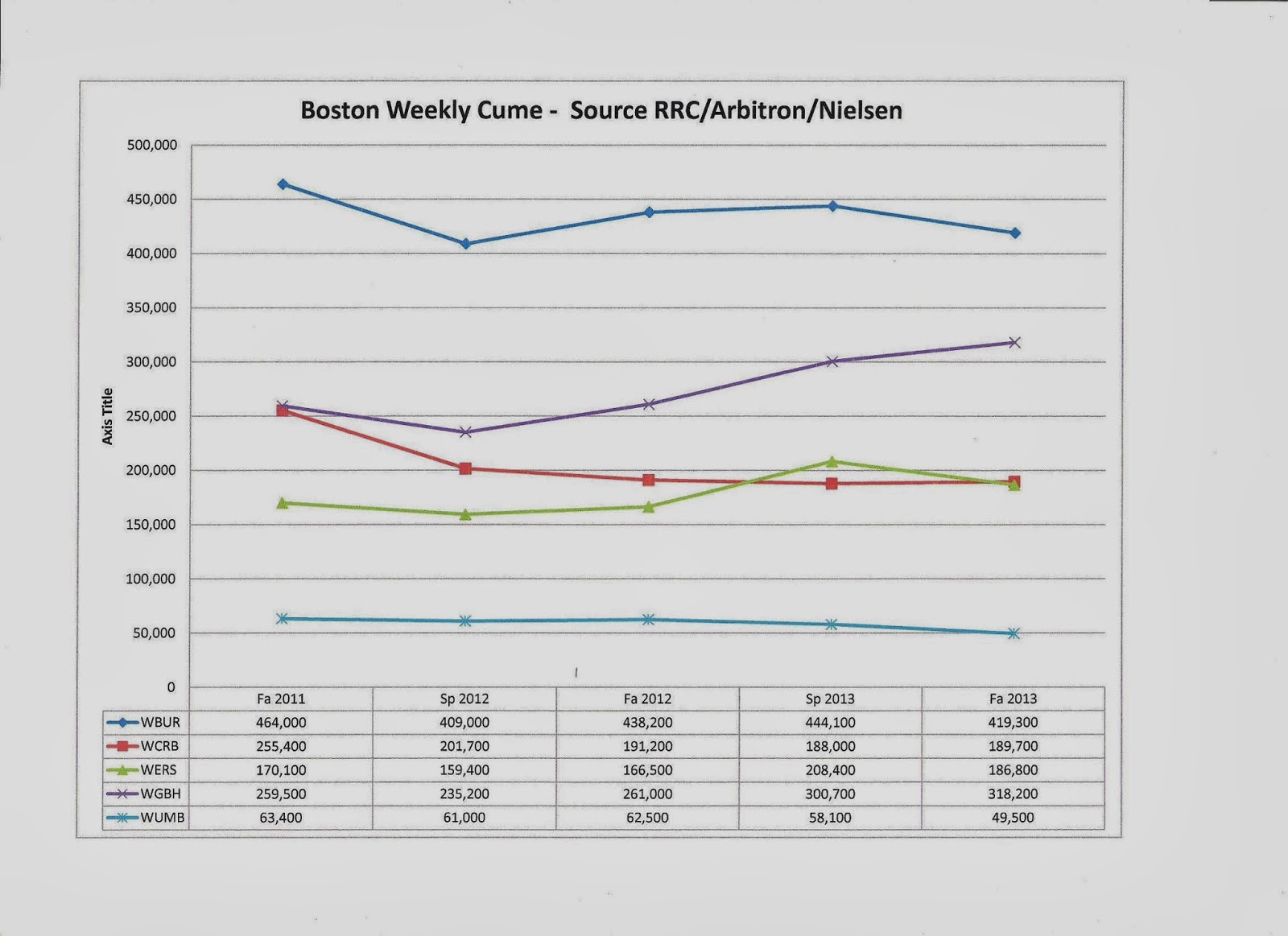
It has been over two years since the change. Enough time has elapsed to get an idea of audience trends. The results are mixed. WGBH is showing growth. WCRB (the station with the weaker signal) is not showing growth. Looking at topline figures for five public radio stations using Fall and Spring Quarter data starting with the Fall Quarter from 2011 to the present you can get a sense of where things have gone in Boston. WBUR is holding onto its share of the Boston audience. WGBH is growing its average audience, share and cume. WCRB is declining in all three metrics. WERS, with its eclectic music programming, has a large weekly cume but, they have a very high turnover ratio. WUMB continues to bump against the bottom. Whatever they're doing isn't having much of an effect on the audience. I worked at WUMB for a short while at the end of 2010 and the start of 2011. Audience figures are pretty much the same as they were back then.
WGBH saw the need for change. Despite criticism and negative feedback, they are beginning to see postive results.
Steel Yourself
Change is something I'm familiar with. I helped shepherd two changes at WNPR. The first came in 1989 when WNPR took control of its programming in the morning. The phone calls and letters from contributors were sharply critical. The press was negative. Letters to the editor ran heavily against the changes. The results were positive with growth in audience and member dollars. In 2006, when the format changed to include more news and information, the feedback was more intense. The Hartford Courant devoted a front page article with a banner headline to the change. The article was not positive. It lamented the loss of classical music and, at the same time, included a sidebar with a list of eight other stations in the market that still carried the genre. Over 4,000 complaints came in from members. Major donors were bending the ear of the CEO. He had his doubts about the change from the beginning. The complaints reinforced his doubts.
Before the change we did our homework. We measured the effects the change would have on our membership by splitting them into groups called imperatives. They were News Imperatives, Crossover Imperatives, and Classical Imperatives. In our survey, we paid particular attention to what would happen to the Crossover Imperative. We already knew the News Imperatives would be supportive. And, we knew the Classical Imperatives would leave us. The question was, "Would the Crossover Imperatives remain in sufficient numbers to sustain our membership dollars over the short term?” The answer seemed to be yes. Still, there was some uncertainty. When contemplating the change it is important to understand that the reaction from many contributors will be negative. They contribute because they like the station the way it is.
It takes courage to make changes in public radio. The onslaught of complaints wilted some including senior management. My performance review that first year was blistering.
A Positive Outcome
In the first year our audience grew and became more loyal. Membership dollars remained stable. The number of members decreased slightly. Our corporate and foundation support grew 500 percent!
Contemplating change? It takes research, planning and courage.
In the end, the Boston market may be robust enough to support competition for the Public Radio Audience.
The data below is from RRC, Arbitron and Nielsen. I've used AQH Persons, AQH Share and Weekly Cume to give a sense of the trends.
In 2011, when WGBH made changes, they were roundly criticized. At the end of 2011 WGBH split off its news service and created a separate classical and music service on WCRB. There were loud complaints from WBUR about diluting the NPR news audience. There were complaints from long-time classical listeners. WCRB's signal was much weaker than WGBH's. Many in the system doubted WGBH's move, wondering if the news market in Boston could support two NPR stations. For its part, WGBH came to the conclusion they could no longer be a viable public media operation being all things to all people on one signal.
So what happened? Early results were not encouraging. Audience figures did not show growth. Despite the fact that looking at early results is unreliable, many thought it proved the point that WGBH had made a huge mistake.
Taking the Long View
It has been over two years since the change. Enough time has elapsed to get an idea of audience trends. The results are mixed. WGBH is showing growth. WCRB (the station with the weaker signal) is not showing growth. Looking at topline figures for five public radio stations using Fall and Spring Quarter data starting with the Fall Quarter from 2011 to the present you can get a sense of where things have gone in Boston. WBUR is holding onto its share of the Boston audience. WGBH is growing its average audience, share and cume. WCRB is declining in all three metrics. WERS, with its eclectic music programming, has a large weekly cume but, they have a very high turnover ratio. WUMB continues to bump against the bottom. Whatever they're doing isn't having much of an effect on the audience. I worked at WUMB for a short while at the end of 2010 and the start of 2011. Audience figures are pretty much the same as they were back then.
WGBH saw the need for change. Despite criticism and negative feedback, they are beginning to see postive results.
Steel Yourself
Change is something I'm familiar with. I helped shepherd two changes at WNPR. The first came in 1989 when WNPR took control of its programming in the morning. The phone calls and letters from contributors were sharply critical. The press was negative. Letters to the editor ran heavily against the changes. The results were positive with growth in audience and member dollars. In 2006, when the format changed to include more news and information, the feedback was more intense. The Hartford Courant devoted a front page article with a banner headline to the change. The article was not positive. It lamented the loss of classical music and, at the same time, included a sidebar with a list of eight other stations in the market that still carried the genre. Over 4,000 complaints came in from members. Major donors were bending the ear of the CEO. He had his doubts about the change from the beginning. The complaints reinforced his doubts.
Before the change we did our homework. We measured the effects the change would have on our membership by splitting them into groups called imperatives. They were News Imperatives, Crossover Imperatives, and Classical Imperatives. In our survey, we paid particular attention to what would happen to the Crossover Imperative. We already knew the News Imperatives would be supportive. And, we knew the Classical Imperatives would leave us. The question was, "Would the Crossover Imperatives remain in sufficient numbers to sustain our membership dollars over the short term?” The answer seemed to be yes. Still, there was some uncertainty. When contemplating the change it is important to understand that the reaction from many contributors will be negative. They contribute because they like the station the way it is.
It takes courage to make changes in public radio. The onslaught of complaints wilted some including senior management. My performance review that first year was blistering.
A Positive Outcome
In the first year our audience grew and became more loyal. Membership dollars remained stable. The number of members decreased slightly. Our corporate and foundation support grew 500 percent!
Contemplating change? It takes research, planning and courage.
In the end, the Boston market may be robust enough to support competition for the Public Radio Audience.
The data below is from RRC, Arbitron and Nielsen. I've used AQH Persons, AQH Share and Weekly Cume to give a sense of the trends.


Monday, February 11, 2013
WGBH Canvassing for Dollars
WGBH is canvassing for dollars.
If a potential donor needs to know about a service and use a service before they are inclined to give to the service...
Will this work?
Is this effective?
What is the rate of response?
What is the ROI?
Fund raising is lot like fishing. To be successful...fish where the fish are. So, am I all wet?
If a potential donor needs to know about a service and use a service before they are inclined to give to the service...
Will this work?
Is this effective?
What is the rate of response?
What is the ROI?
Fund raising is lot like fishing. To be successful...fish where the fish are. So, am I all wet?
Canvass for WGBH-- Keep Public Broadcasting Strong
Donor Development Strategies, LLC - Boston, MA
Donor Development Strategies, LLC - Boston, MA
| Donor Development Strategies, LLC is looking for responsible individuals with a strong work ethic and good communication skills to raise money and sign up members for WGBH, Boston's public media powerhouse. WGBH has been an essential community resource for over 60 years, providing unique programs to all six New England states. Whether you grew up watching WGBH's children's programs, appreciate all of WGBH's great drama, science, and history programs, or enjoy the best of public radio on 99.5, Classical New England and 89.7, WGBH has probably served your life in critical ways. Donor Development Strategies, LLC is hiring people to increase WGBH awareness and membership by going door-to-door to encourage New Englanders to help keep public broadcasting alive. Learn the basics of membership building and fundraising in a rewarding, fun environment while engaging individuals, working mostly outside, and gaining a sense of accomplishment. Entry-level pay starts at $10/hour with potential to earn up to $20/hour. Competitive benefits package. Experienced canvassers will be considered for immediate leadership positions. Call Hunter at Donor Development Strategies at 617-300-3218 to learn more and set up an interview, or apply online at http://donordevelopmentstrategies.com/index.php?option=com_forme&fid=3 idealist.org - 2 days ago |
Wednesday, January 2, 2013
Boston's WTKK Ending Talk Format
The Boston Globe and other sources are reporting that WTKK-FM is changing formats. The all talk format will give way to a music format. Media analysts cited in the article say the station never developed a niche in a crowded market and, the rating reflected that.
Scott Fybush, editor of the trade journal NorthEast Radio Watch, told the Globe that the WTKK never developed a stationality. In other words, there did not seem to be a unified approach to the content that would promote listening to the station over the course of the day. When listeners tune in they should know what they are getting. A consistent format with programs that have a high affinity with each other promotes more time spent listening and a stronger share of the market.
These concepts are not unfamiliar to public radio. They were expanded on in the Audience 88 and 98 reports. The reports were published by David Giovannoni with the help of many others. They are available through ARANet.com
One of the stations mentioned in the Globe article, WBUR, embraced these concepts early-on. WGBH embraced them within the past few years.
Wednesday, February 1, 2012
There's an app for that - WGBH Magazine and Guide
WGBH has a a new iPad app for its Magazine and Program listings. According to the press release (you can see the whole release here) WGBH is using Adobe DPS,
the preeminent solution for Adobe InDesign®-based tablet publishing, to produce
the iPad edition of Explore!, the organization’s monthly magazine for members
and public media’s first program guide designed especially for tablets.
The app will deliver live updates, interactive features, videos and behind the scenes videos.
This adds new dimensions to the guide experience. My previous experience with print guides has been to question the value of the guide to the listener and viewer and, to question the cost of the guide. Perhaps this can change the equation. Unique and up to date material should be a value added experience for the user.
The app will deliver live updates, interactive features, videos and behind the scenes videos.
This adds new dimensions to the guide experience. My previous experience with print guides has been to question the value of the guide to the listener and viewer and, to question the cost of the guide. Perhaps this can change the equation. Unique and up to date material should be a value added experience for the user.
Monday, August 22, 2011
WBUR/WGBH Revisited
WGBH and WBUR continue to compete for the same market share...the NPR news listener. It was feared when WGBH switched formats to News and information that the move would split the audience. It hasn't quite turned out that way.
Certainly WBUR lost share of the market while WGBH made very modest gains. More importantly, public radio collectively lost share of the Boston Market. Public Radio's Share of the market, (Persons 6+) according to PPM data provided by RRC, has dropped from 9.5% to 7.0% of the radio audience.

I compared the quarterly topline reports from Winter 2010 to Spring 2011.
Without more data, I can only guess at what is happening. It seems public radio is less appealing now to the Boston Market than it was in the Winter of 2010.
Certainly WBUR lost share of the market while WGBH made very modest gains. More importantly, public radio collectively lost share of the Boston Market. Public Radio's Share of the market, (Persons 6+) according to PPM data provided by RRC, has dropped from 9.5% to 7.0% of the radio audience.

I compared the quarterly topline reports from Winter 2010 to Spring 2011.
Without more data, I can only guess at what is happening. It seems public radio is less appealing now to the Boston Market than it was in the Winter of 2010.
Thursday, August 4, 2011
Collaborative Marketing for Public Radio
As I read some of what was said at the Public Radio Development Conference about the need for consolidation and collaboration, I thought about a similar effort in public television. Connecticut Public Television, WTTW and a few others created a marketing partnership to garner underwriting funds for stations by pooling efforts. Market exclusivity was one of the key points. The agreement was competitive. Not only would these station have more marketing clout against local commercial affiliates, but they would also have more clout against public television stations not in the consortium. The consortium failed. They were unable to sign clients interested in underwriting on these stations as a group.
What if the idea was focused on markets? What if public radio stations within a market were to pool resources to garner underwriters?
This idea would work best in markets where there is very little program overlap. Baltimore might be a good example. WBJC offers classical music with an audience share o 2.2%. WEAA offers Jazz and programming aimed to serve minorities with an audience share of 0.6%. WTMD is a AAA station with a share of 0.7 percent. WYPR is Baltimore's NPR station with a share of 3.1%. Individually, station shares are moderate to small. Collectively the audience share is a respectable 6.6%. The top station in the market is WWIN (MAGIC95.9) P6+ in BALTIMORE in JUNE with an 8.9 share.
Of course, this assumes the stations within a market would be willing to collaborate to create more marketing clout.
Philadelphia is another market where the public radio stations could benefit from a combined marketing effort. The combined cume of WHYY, WRTI and WXPN is 6.2% according to Arbitron PPM figures for the Spring Quarter provided by RRC
Some stations already benefit from having more than one signal in a market with a different format on each of the signals. Minnesota Public Radio, Colorado Public Radio, New York Public Radio and WGBH, Boston benefit from cross-format marketing. This is something I proposed at CPBI. If approved, the combined share could have been 6%.
Combining shares:
What if the idea was focused on markets? What if public radio stations within a market were to pool resources to garner underwriters?
This idea would work best in markets where there is very little program overlap. Baltimore might be a good example. WBJC offers classical music with an audience share o 2.2%. WEAA offers Jazz and programming aimed to serve minorities with an audience share of 0.6%. WTMD is a AAA station with a share of 0.7 percent. WYPR is Baltimore's NPR station with a share of 3.1%. Individually, station shares are moderate to small. Collectively the audience share is a respectable 6.6%. The top station in the market is WWIN (MAGIC95.9) P6+ in BALTIMORE in JUNE with an 8.9 share.
Of course, this assumes the stations within a market would be willing to collaborate to create more marketing clout.
Philadelphia is another market where the public radio stations could benefit from a combined marketing effort. The combined cume of WHYY, WRTI and WXPN is 6.2% according to Arbitron PPM figures for the Spring Quarter provided by RRC
Some stations already benefit from having more than one signal in a market with a different format on each of the signals. Minnesota Public Radio, Colorado Public Radio, New York Public Radio and WGBH, Boston benefit from cross-format marketing. This is something I proposed at CPBI. If approved, the combined share could have been 6%.
Combining shares:
- MPR 10.8%
- CPR 5.6% (CPR is about to add a third format)
- WGBH/WCRB 3.1%
- WNYC/WQXR 4.2%
How could individual stations share combined underwriting revenue? A simple idea would be to divide up the revenue by listener hours. That could be done for the entire topline or for specific dayparts depending the client's contract.
Monday, April 25, 2011
WBUR - Feeling the sting of competition Part Two
One of the things we used to talk about was that having more stations below 92 on the dial would raise all boats. That is, if there were more stations carrying NPR content, more listeners would come to public radio.
My question - are more listeners coming to public radio after the switch by WGBH to NPR news/talk? I cannot give you public radio's total Cume audience. I can give you public radio's share over time.
Based on topline figures the trend line shows public radio's share of the market is decreasing. WGBH's trend line is slightly upward. WBUR's trend line shows they have lost about a half point. Average audience for public radio is also declining. Declines in share and average audience for WBUR may be due in part to increased competition between WGBH and WBUR. Another factor is a decline in Public Radio's share of the radio market. Decreased listening to public radio in the Boston market is contributing to WBUR's decline.
One more thing to consider. The starting point...the month WGBH switched formats...may be skewed. The increased attention brought on by the publicity may have inflated the number of listeners sampling public radio. Eliminating December 2009 from the chart slightly lessens the decreasing trends for public radio and for WBUR, but not entirely.


Sunday, April 24, 2011
WGBH changes sting public radio rival - The Boston Globe
WGBH changes sting public radio rival - The Boston Globe
I'm bothered by the horse race aspect of this article.
Here's why:
A weakness of the month to month system employed by Arbitron with PPM is the volatility of the numbers. To be sure, they are more reliable than the diary numbers. Still, there is a certain amount of bounce in the estimates from month to month.
Using trends is much more reliable. The six month average in The Vital Signs Report available to public radio stations by RRC offers even more reliability.
Using trends is much more reliable. The six month average in The Vital Signs Report available to public radio stations by RRC offers even more reliability.
Trending average audience share figures from Arbitron 6+ PPM Metro Boston show modest gains for WGBH in the past six months. WBUR's trend is flat. The other major player among public radio stations in Boston,WCRB, is trending downward.
The numbers being used are for Boston Metro and do not reflect the audience estimates for WGBH and WBUR outside the Boston Metro Market.

Nov 10 Dec 10 Hol 10 Jan 10 Feb 10 Mar 10
WBUR 3.9% 3.5% 3.1% 4.0% 3.7% 3.6%
WCRB 2.4% 2.2% 2.9% 2.4% 1.9% 2.1%
WGBH 1.5% 1.4% 1.2% 1.7% 1.6% 1.4%

Nov 10 Dec 10 Hol 10 Jan 10 Feb 10 Mar 10
WBUR 3.9% 3.5% 3.1% 4.0% 3.7% 3.6%
WCRB 2.4% 2.2% 2.9% 2.4% 1.9% 2.1%
WGBH 1.5% 1.4% 1.2% 1.7% 1.6% 1.4%
Saturday, December 11, 2010
WBUR’s new ad campaign is a rarity for public radio - The Boston Globe
WBUR’s new ad campaign is a rarity for public radio - The Boston Globe
The competition for public radio's news audience continues in Boston. WBUR has a new billboard campaign. WGBH has the ability to cross promote with it's other radio stations and it's public TV station. So, how is it going? "Last month, WBUR drew a weekly audience of 455,400 listeners to its daytime programming, while WGBH attracted 258,900 listeners."
Billboard campaigns for public radio in the past have had mixed results. Certainly, they increase awareness. In my experience, there has been little evidence of audience growth as a result of the campaigns I've been involved with.
Billboard campaigns for public radio in the past have had mixed results. Certainly, they increase awareness. In my experience, there has been little evidence of audience growth as a result of the campaigns I've been involved with.
Check out the article by Johhny Diaz in the Boston Globe from December 11, 2010.
Sunday, June 27, 2010
After format swap, WGBH lags behind WBUR in ratings
After format swap, WGBH lags behind WBUR in ratings
Found in the Boston Herald.com by Jessica Heslam.
While WBUR has WGBH beat so far, Fleming said his station is still concerned about the newcomer, but it’s forced them to “focus in on what we do well.”
If this is going to work for WGBH, they will need to take the long view. The news is not so bad for their classical service. WCRB has 2.2 share in April and a 2.6 share for the winter quarter according to Arbitron and the Radio Research Consortium.
Found in the Boston Herald.com by Jessica Heslam.
The 1.0 share for WGBH has to be disappointing. It is not the end of the world.
There are two great comments that put this into perspective.
Boston radio consultant and Lesley University professor Donna Halper said this is a marathon - not a sprint. “I’ve been consulting for 30 years and there is no history of a talk radio format, particularly on public broadcasting, storming in and taking over the world,” Halper said.
While WBUR has WGBH beat so far, Fleming said his station is still concerned about the newcomer, but it’s forced them to “focus in on what we do well.”
If this is going to work for WGBH, they will need to take the long view. The news is not so bad for their classical service. WCRB has 2.2 share in April and a 2.6 share for the winter quarter according to Arbitron and the Radio Research Consortium.
Saturday, April 17, 2010
Overlapping news programs blur line between WBUR and WGBH - The Boston Globe
There's an interesting article in the Boston Globe by Johnny Diaz about the efforts WBUR and WGBH are making to differentiate themselves from each other. There's anecdotal evidence in the article about listener dissatisfaction with duplication of programming. (There's more of that in the comments section.)
It's way too soon to tell how this will shake out. The audience figures in the article represent listening for one month. More significant will be the one year trends in Average Persons and AQH Share. Plus, a look at the changing dynamics of crossover and shared audience, after a year, will give more insight into blurring distinctions.
Overlapping news programs blur line between WBUR, WGBH radio stations - The Boston Globe
Posted using ShareThis
It's way too soon to tell how this will shake out. The audience figures in the article represent listening for one month. More significant will be the one year trends in Average Persons and AQH Share. Plus, a look at the changing dynamics of crossover and shared audience, after a year, will give more insight into blurring distinctions.
Overlapping news programs blur line between WBUR, WGBH radio stations - The Boston Globe
Posted using ShareThis
Wednesday, December 23, 2009
WGBH Changes Leads to Dissent

The negative blow-back that WGBH is getting from listeners about the recent program changes is to be expected. In a way we in public media enable a sense of ownership over the programming through our membership campaigns. We ask listeners to become activists when we ask for their support, and they become invested. Despite the fact that ratings, loyalty figures and support dollars may be below what is needed to sustain programming, there those who did invest who will feel alienated by the changes.
Take a look at the article from the Boston Herald By Daniel Gerwetz and then drop down to the comments. Recent changes at KUT in Austin and WDET in Detroit have led to similar protests.
You can make changes for all the right reasons, but for some listeners those reasons won't matter. They're felling a sense of loss and betrayal. Management and the major stakeholders need to be prepared and be able to weather the storm.
To be sure there are other issues surrounding the changes made by WGBH. Not the least of which is the question; is there room for two public radio news and information stations in the Boston market. WBUR is well established as the NPR news station. WBUR's ratings are four times that of WGBH according to the Herald article. WCRB's ratings were three times that of WGBH. That made their NPR news service and classical music service second choice among both audiences. Being second choice directly affects the stations ability to raise listener sensitive income. In a down economy difficulty raising listener support is not a comfortable position to be in.
Take a look at the article from the Boston Herald By Daniel Gerwetz and then drop down to the comments. Recent changes at KUT in Austin and WDET in Detroit have led to similar protests.
You can make changes for all the right reasons, but for some listeners those reasons won't matter. They're felling a sense of loss and betrayal. Management and the major stakeholders need to be prepared and be able to weather the storm.
To be sure there are other issues surrounding the changes made by WGBH. Not the least of which is the question; is there room for two public radio news and information stations in the Boston market. WBUR is well established as the NPR news station. WBUR's ratings are four times that of WGBH according to the Herald article. WCRB's ratings were three times that of WGBH. That made their NPR news service and classical music service second choice among both audiences. Being second choice directly affects the stations ability to raise listener sensitive income. In a down economy difficulty raising listener support is not a comfortable position to be in.
Monday, November 30, 2009
WGBH bringing TV shows to radio

WGBH-FM becomes Boston's next public radio news and information station. They'll begin as Boston's third service behind WBUR and WBZ. WGBH plans to sprinkle their schedule with made for TV fair from WGBH-TV including the NewsHour. In an article published in the Boston Globe WGBH spokesperson Jeanne Hopkins explains, “We want to do something that is additive, that complements what is already in town and do it in another way.’’ WGBH talks about adapting this programming for radio, but does not talk about the disparity in age cohorts. Is this meant to drive new audiences to WGBH-TV or grow the audience for WGBH-FM?
Subscribe to:
Posts (Atom)