Public Radio International (PRI) announced yesterday that it will end distribution of This American Life (TAL). According to the article in Variety, TAL has 2.2 million listeners and calls the weekly program one of PRI's most popular.
Details of why the show is being dropped are sketchy. PRI Executive Julia Yager states,“During our most recent negotiation, it became clear that our organizations’ expectations regarding our futures were different.” Yager said This American Life will continue to be distributed to Public Radio. Three possible sources, PRX, NPR and APM have not commented yet.
Vermont Public Radio is reporting Vermont Public Television will be able to keep's its funding from The Corporation for Public Broadcasting.
Vermont Public Television (VPT) could have lost $1 million in funding. Funding form the Corporation for Public Broadcasting (CPB) for VPT was in question after allegations that the network had violated open meetings rules. An audit found in February the station had not violated the public meeting rules but had inadvertently failed to notify the public of the private meetings. Several news sources in Vermont have been following the controversy including The Daily Journal. According to the report there were 22 meetings in question. 18 should have been posted on VPT's website. Four of the meetings were not held. The Chair, Pamela MacKenzie and the Vice Chairman Rob Hofmann will remain in their positions. There had been calls for their resignations.
The Infinite Dial 2014 is reporting that the weekly audience for on-line radio is now 36% of all Americans. The findings are from Edison Research and Triton Digital. 94 million Americans now listen on-line.
Monthly Online Radio Audience Approaching Half of Americans
Three-Quarters of 12-24s and Half of 25-54s Listen to Online Radio Monthly
PANDORA leads the music only services with 31% of the audience
Mobile devices are creating a surge in on-line services. According the Triton COO, Mike Agovino “Scaling connectivity across a plethora of devices is enabling tremendous growth in online radio consumption."
This might mean adapt or get lost in the shuffle. Radio is still relevant but, the way it is being consumed is shifting rapidly to a variety of platforms.
WGBH Shows Growth
In 2011, when WGBH made changes, they were roundly criticized. At the end of
2011 WGBH split off its news service and created a separate classical and music
service on WCRB. There were loud complaints from WBUR about diluting the NPR
news audience. There were complaints from long-time classical listeners. WCRB's
signal was much weaker than WGBH's. Many in the system doubted WGBH's move,
wondering if the news market in Boston could support two NPR stations. For its
part, WGBH came to the conclusion they could no longer be a viable public media
operation being all things to all people on one signal.
So what happened? Early results were not encouraging. Audience figures did not
show growth. Despite the fact that looking at early results is unreliable, many
thought it proved the point that WGBH had made a huge mistake.
Taking the Long View
It has been over two years since the change. Enough time has elapsed to get an
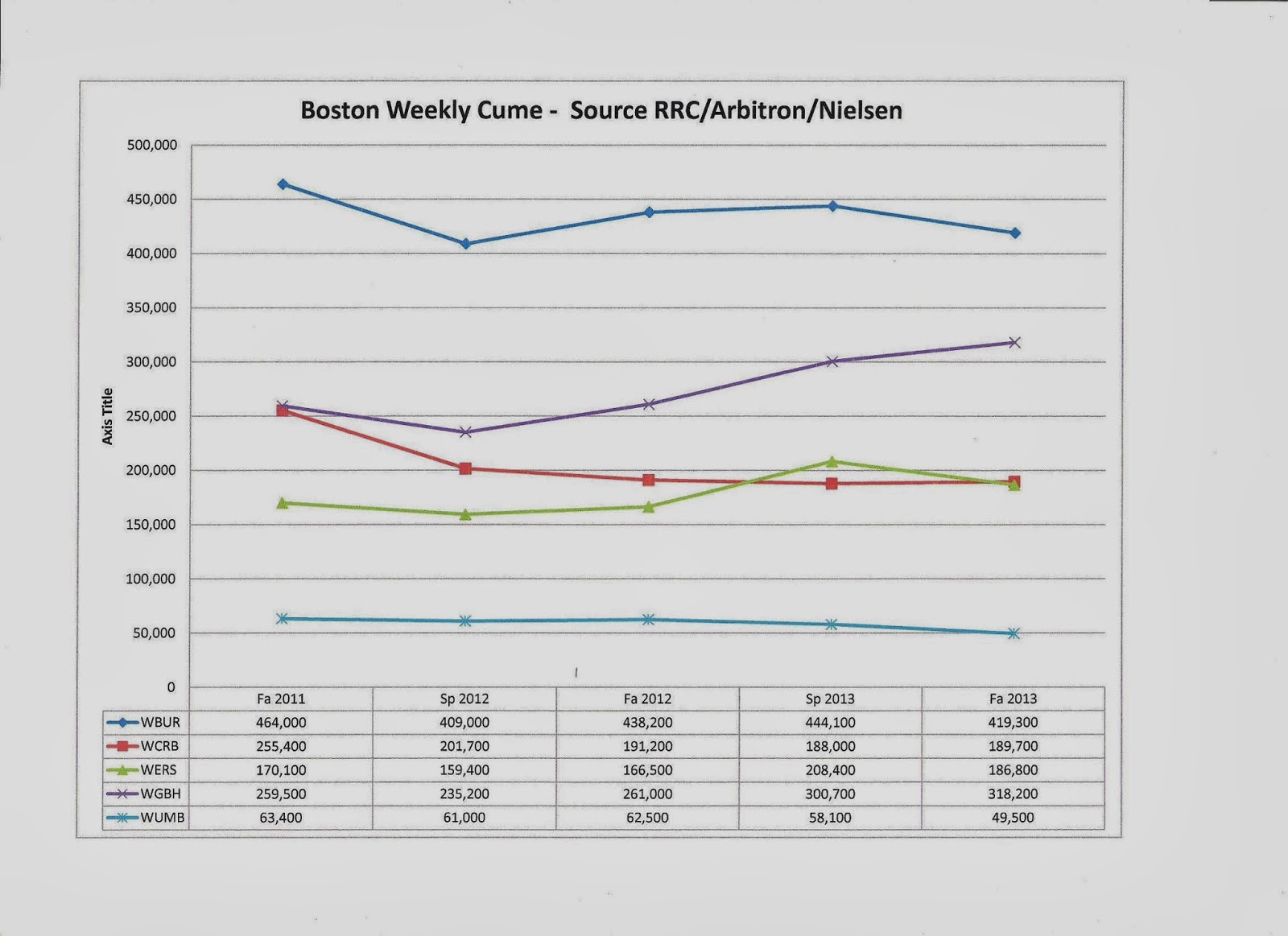
idea of audience trends. The results are mixed. WGBH is showing growth. WCRB
(the station with the weaker signal) is not showing growth. Looking at
topline figures for five public radio stations using Fall and Spring Quarter
data starting with the Fall Quarter from 2011 to the present you can get a
sense of where things have gone in Boston. WBUR is holding onto its share of
the Boston audience. WGBH is growing its average audience, share and cume. WCRB
is declining in all three metrics. WERS, with its eclectic music programming,
has a large weekly cume but, they have a very high turnover ratio. WUMB
continues to bump against the bottom. Whatever they're doing isn't having much
of an effect on the audience. I worked at WUMB for a short while at the end of
2010 and the start of 2011. Audience figures are pretty much the same as they
were back then.
WGBH saw the need for change. Despite criticism and negative feedback, they are
beginning to see postive results.
Steel Yourself
Change is something I'm familiar with. I helped shepherd two changes at WNPR.
The first came in 1989 when WNPR took control of its programming in the
morning. The phone calls and letters from contributors were sharply critical.
The press was negative. Letters to the editor ran heavily against the changes.
The results were positive with growth in audience and member dollars. In 2006,
when the format changed to include more news and information, the feedback was
more intense. The Hartford Courant devoted a front page article with a banner
headline to the change. The article was not positive. It lamented the loss of
classical music and, at the same time, included a sidebar with a list of eight
other stations in the market that still carried the genre. Over 4,000
complaints came in from members. Major donors were bending the ear of the CEO.
He had his doubts about the change from the beginning. The complaints
reinforced his doubts.
Before the change we did our homework. We measured the effects the change would
have on our membership by splitting them into groups called imperatives. They
were News Imperatives, Crossover Imperatives, and Classical Imperatives. In our
survey, we paid particular attention to what would happen to the Crossover
Imperative. We already knew the News Imperatives would be supportive. And, we
knew the Classical Imperatives would leave us. The question was, "Would
the Crossover Imperatives remain in sufficient numbers to sustain our membership
dollars over the short term?” The answer seemed to be yes. Still, there was
some uncertainty. When contemplating the change it is important to understand
that the reaction from many contributors will be negative. They contribute
because they like the station the way it is.
It takes courage to make changes in public radio. The onslaught of complaints
wilted some including senior management. My performance review that first
year was blistering.
A Positive Outcome
In the first year our audience grew and became more loyal. Membership dollars
remained stable. The number of members decreased slightly. Our corporate and
foundation support grew 500 percent!
Contemplating change? It takes research, planning and courage.
In the end, the Boston market may be robust enough to support competition for
the Public Radio Audience.
The data below is from RRC, Arbitron and Nielsen. I've used AQH Persons, AQH
Share and Weekly Cume to give a sense of the trends.
I got the chance to meet Pete Seeger. I didn't know it at the time but, the meeting was life changing. The changes were so gradual I didn't really think about them until Pete's passing last week.
It was the mid 60's. I was in high school. The people I hung with were musician wanna be's. We all played. I had taught myself some chords and a couple of lead riffs on guitar. I sang some tunes too. At the time there was a blending of folk and and rock mixed withe the British invasion. I think we all had dreams of making it big. Never mind the talent level, we had a lot of fun.
Appealing to Youthful Rebellion
I got a call from Ron Cope one afternoon. He said, "Pete Seeger is going to be at the Oriental tomorrow night." "Do you want to go?" Without hesitation I said, "Yes." Ron then said, "You know, he's a communist?"
The politics in our high school was Republican and Conservative. The thought of going to see a communist perform seemed slightly rebellious. We went over slight objections from our parents. I found out later that Seeger had quit the communist party about 1950 over objections of the abuses of Stalin's regime.
Pete played and told stories. He talked about social justice and causes. The songs he sang were mostly from the civil rights movement. There were also songs from the labor movement and some adaptations of music from around the world. His two hour performance was intense and drew me in. It was just Pete singing and accompanying himself on guitar or banjo.
The Experience was Personal
After the concert we walked backstage and took the stairs to his dressing room...uninvited. (try that today) He looked tired but, he was gracious and smiled at us when we asked about his twelve string and his banjo playing style. He spent about ten minutes talking with us. Nobody else came up. The moment was magic.
After the concert I bought one of his albums, "We Shall Overcome." I played that album until the grooves wore out.
New Perspectives
His music opened my mind to new ways of thinking about issues. It didn't make me a radical...more of a progressive. Progressive in the sense of creating a level playing field as opposed to creating barriers. The level playing field, or equal opportunities should be in place in order for all of us to be allowed to reach our full potential. The politics aren't as important as the desire to look at issues and ideas in different ways...To explore and understand the perspectives of others. Social justice became a strong theme in my life. The music...the event...changed my life.
That sense of caring about community brought me to Public Radio and to the FOCUS Center for Autism. Thanks, Pete!
Downton Abbey is proving to be a ratings winner. According to the New York Times, 10.2 million viewers tuned in to the season premier.
The total number of contributors for Public TV have been in decline since 2002. The number of contributors for Public Radio has been increasing. In fact, the number of contributors for Public Radio and Public Television intersected in 2012. (Look Here)
Reversing the trend for Public TV will take more than Downton Abbey. PTV could use three or four more programs like this to create positive buzz and create consistent growth. Growth in audience around compelling programming will result in growth of viewer support. Fundraising is effective when the development department has great content driving audience.
Christmas With Jim Glynn
Back in the day...I used to work on all the holidays. It was a part my job as Music Director for WUWM. I was responsible for scheduling music programming including on-air staff. Most of the music shifts were filled by volunteers and students. Full-time staff would fill-in as needed and, around the holidays we were needed. We did the work but, all of us would rather have been with our families.
The most memorable came around Christmas. To be sure, I didn't want to be there. But, something changed for me when filling in as board operator for Jim Glynn. Jim was a musician and one of our jazz announcers. His shift was on Friday nights. The music reflected his tastes and Jim as an individual. His music was mellow as was his conversation. I enjoyed the laid-back atmosphere he created. Jim preferred to be in the control room with the operator for better interaction so, the conversation between stopsets flowed freely and the topics were broad and always interesting.
Christmas fell on the Friday and Saturday in successive years. Both years I brought refreshments; oranges, chocolate and tea. The music, conversation and treats were shared freely. I truly enjoyed the interaction with Jim. It was a great combination. Good Music - Good Food - Good Conversation. The flavors, music and the conversation made for memorable evenings. It's a Christmas experience I will always remember. Thanks, Jim and Merry Christmas!