Sunday, April 20, 2014

Iowa Public Radio Needs Funding Boost


"A Change Will do You Good"

Sometimes. And sometimes it takes a while for the change to take effect. Iowa Public Radio (IPR) needs funding from Iowa's Public Universities to make up for shortfalls. Turmoil at the top resulted in funding problems according to IPR leadership.

The Creston News Advertiser reports "IPR had an extended period with interim leadership, which resulted in interrupting the plan to increase funding from large donors.” IPR is asking for over $235,000 in additional support from the university regents. The strategic plan was to be free from university funding by 2017.

CEO Mary Grace Herrington was fired by the board in 2013. Some of the board members publicly discussed the firing. The result was a settlement for Herrington of $197,000.

IPR hired a new CEO in January. Myrna Johnson was new executive director.
The report, published Friday, credits  The Gazette, Cedar Rapids, Iowa (MCT) Vanessa Miller (McClatchy/Tribune - MCT Information Services)

Monday, April 7, 2014

Millennial Gateway for Public Radio


Two programs distributed by APM are being touted as hip and trendy for Millennials.

MPR now stands for millennial public radio

Concern within public radio is the aging of the audience and how the younger audience uses radio. The hope is shows like "Wits" and "The Dinner Party Download" will draw younger listeners to public radio. Both programs are distributed nationally. According to the article in the Minneapolis Star, the audience is still small for programs with national distribution. "The Dinner Party Download" draws 250,000 listeners on 130 stations. "Wits" has 131,500 listeners in 100 markets nationally. A Prairie Home Companion  (APHC) also distributed by APM, draws 4 million listeners on 679 stations. APHC's audierceis centered on the Boomers.

Listener measurements listed in the article are based on station based statistics. They do not include on-demand listening through hand held devices, web downloads and streaming. Millennials listen at their convenience...not at the station's. Still, when public radio was new we talked about All Things Considered and Morning Edition being the gateway for the rest of our programming. The concept of gateway programming worked then. It could work now.

Thursday, March 27, 2014

Houston Public Media Spells It Out


spelling-bee_page.png


It's an annual thing for Houston Public Media. This will be the sixth time Houston Public Media (Channel 8) broadcasts the Scripps affiliated local Spelling Bee. They will also stream the event

Houston Public Media broadcasts and live streams nation’s third largest local spelling bee on March 29 - Your Houston News: News

There will be 55 spellers from over 1,000 schools.

This year's contest and contestants are set but, Houston Public Media offers information on how schools and students in Texas can get involved.  

2014 Houston Public Media Spelling Bee

It seems like a great way to engage schools, children and their families.


Friday, March 21, 2014

This American Life / PRI Part Ways


Public Radio International (PRI) announced yesterday that it will end distribution of This American Life (TAL). According to the article in Variety, TAL has 2.2 million listeners and calls the weekly program one of PRI's most popular.


Details of why the show is being dropped are sketchy. PRI Executive Julia Yager states, “During our most recent negotiation, it became clear that our organizations’ expectations regarding our futures were different.” 

Yager said This American Life will continue to be distributed to Public Radio. Three possible sources, PRX, NPR and APM have not commented yet.


Monday, March 17, 2014

CPB Funding Safe at VPT


Vermont Public Radio is reporting Vermont Public Television will be able to keep's its funding from The Corporation for Public Broadcasting.

Vermont Public Television (VPT) could have lost $1 million in funding. Funding form the Corporation for Public Broadcasting (CPB) for VPT was in question after allegations that the network had violated open meetings rules. An audit found in February the station had not violated the public meeting rules but had inadvertently failed to notify the public of the private meetings. Several news sources in Vermont have been following the controversy including The Daily Journal. According to the report there were 22 meetings in question. 18 should have been posted on VPT's website. Four of the meetings were not held.

The Chair, Pamela MacKenzie and the Vice Chairman Rob Hofmann will remain in their positions. There had been calls for their resignations

Thursday, March 6, 2014

Internet Radio Listening is Strong.

The Infinite Dial 2014 is reporting that the weekly audience for on-line radio is now 36% of all Americans. The findings are from Edison Research and Triton Digital. 94 million Americans now listen on-line.
Free Photo - Digital clock
Some of the highlights published by All Access Music Group include:
  • Monthly Online Radio Audience Approaching Half of Americans
  • Three-Quarters of 12-24s and Half of 25-54s Listen to Online Radio Monthly
  • PANDORA leads the music only services with 31% of the audience
Mobile devices are creating a surge in on-line services. According the Triton COO, Mike Agovino “Scaling connectivity across a plethora of devices is enabling tremendous growth in online radio consumption."

This might mean adapt or get lost in the shuffle. Radio is still relevant but, the way it is being consumed is shifting rapidly to a variety of platforms.


Tuesday, February 18, 2014

Some Things Never Change

WGBH Shows Growth
In 2011, when WGBH made changes, they were roundly criticized. At the end of 2011 WGBH split off its news service and created a separate classical and music service on WCRB. There were loud complaints from WBUR about diluting the NPR news audience. There were complaints from long-time classical listeners. WCRB's signal was much weaker than WGBH's. Many in the system doubted WGBH's move, wondering if the news market in Boston could support two NPR stations. For its part, WGBH came to the conclusion they could no longer be a viable public media operation being all things to all people on one signal.

So what happened? Early results were not encouraging. Audience figures did not show growth. Despite the fact that looking at early results is unreliable, many thought it proved the point that WGBH had made a huge mistake.

Taking the Long View
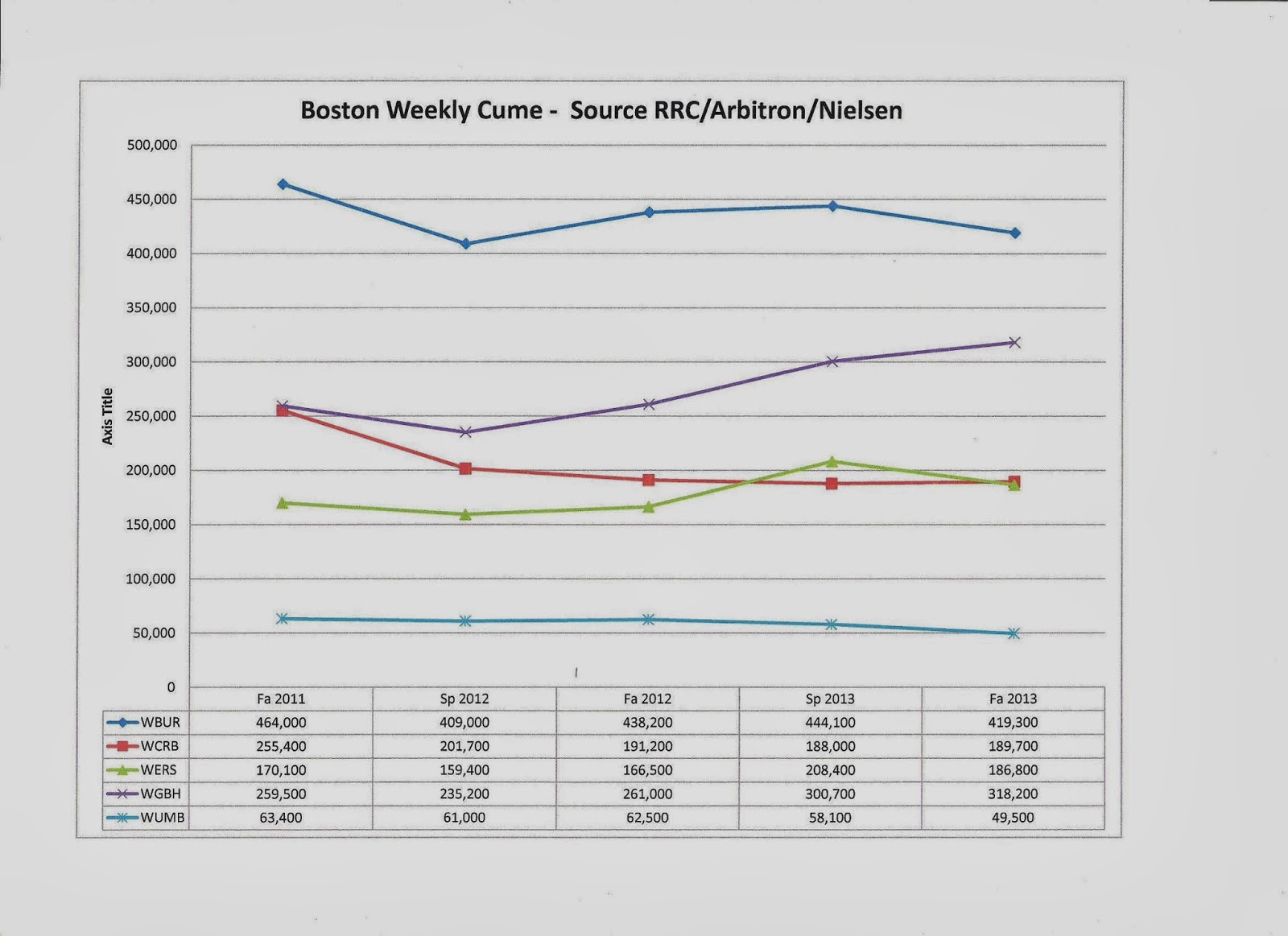
It has been over two years since the change. Enough time has elapsed to get an idea of audience trends. The results are mixed. WGBH is showing growth. WCRB (the station with the weaker signal) is not showing growth.  Looking at topline figures for five public radio stations using Fall and Spring Quarter data starting with the Fall Quarter from 2011 to the present you can get a sense of where things have gone in Boston. WBUR is holding onto its share of the Boston audience. WGBH is growing its average audience, share and cume. WCRB is declining in all three metrics. WERS, with its eclectic music programming, has a large weekly cume but, they have a very high turnover ratio. WUMB continues to bump against the bottom. Whatever they're doing isn't having much of an effect on the audience. I worked at WUMB for a short while at the end of 2010 and the start of 2011. Audience figures are pretty much the same as they were back then.

WGBH saw the need for change. Despite criticism and negative feedback, they are beginning to see postive results.

Steel Yourself
Change is something I'm familiar with. I helped shepherd two changes at WNPR. The first came in 1989 when WNPR took control of its programming in the morning. The phone calls and letters from contributors were sharply critical. The press was negative. Letters to the editor ran heavily against the changes. The results were positive with growth in audience and member dollars. In 2006, when the format changed to include more news and information, the feedback was more intense. The Hartford Courant devoted a front page article with a banner headline to the change. The article was not positive. It lamented the loss of classical music and, at the same time, included a sidebar with a list of eight other stations in the market that still carried the genre. Over 4,000 complaints came in from members. Major donors were bending the ear of the CEO. He had his doubts about the change from the beginning. The complaints reinforced his doubts.

Before the change we did our homework. We measured the effects the change would have on our membership by splitting them into groups called imperatives. They were News Imperatives, Crossover Imperatives, and Classical Imperatives. In our survey, we paid particular attention to what would happen to the Crossover Imperative. We already knew the News Imperatives would be supportive. And, we knew the Classical Imperatives would leave us. The question was, "Would the Crossover Imperatives remain in sufficient numbers to sustain our membership dollars over the short term?” The answer seemed to be yes. Still, there was some uncertainty. When contemplating the change it is important to understand that the reaction from many contributors will be negative. They contribute because they like the station the way it is.

It takes courage to make changes in public radio. The onslaught of complaints wilted some including senior management.  My performance review that first year was blistering.

A Positive Outcome
In the first year our audience grew and became more loyal. Membership dollars remained stable. The number of members decreased slightly. Our corporate and foundation support grew 500 percent!

Contemplating change? It takes research, planning and courage.

In the end, the Boston market may be robust enough to support competition for the Public Radio Audience.

The data below is from RRC, Arbitron and Nielsen. I've used AQH Persons, AQH Share and Weekly Cume to give a sense of the trends.